Thursday, July 28, 2016

A Quest

This is a story about a quest, and also not a quest.

Like stories, quests are contained. They have a beginning, a middle, and an end. This story has one such quest, but the other is not, because it is a quest to battle anxiety. I do not say defeat anxiety, because it is not something that can be defeated like one would slay a dragon. It is part of the daily, ongoing quest that is called living. Most mental health problems are like this; they cannot be fought and "cured," only tamed.

Quests are also like stories because most stories, and especially those from mythology, are about quests. A hero goes on a journey, to find, to capture, or to kill, and eventually to return. These days, our heroes are found in books and movies, and our quests are found in video games, in which you are the hero and you complete the quests.

Most importantly, quests have a purpose, a goal. This is why stories and myths appeal to us: they bring meaning and order to life, which is inherently meaningless and purposeless. (If you disagree with me that life has no over-arching purpose -- as opposed to the small purposes that motivate the actions of living things -- that will have to be a discussion for another day.)

So anyway, I got this adult coloring book.

Jigsaw puzzles are my favorite anxiety-reducing pastime, but they take up a lot of space and aren't very portable. Though to be honest, my absolute favorite way of dealing with anxiety is computer games, but sometimes they have too much associated guilt (as in, "I really shouldn't be playing video games"). Which means sometimes they only reduce anxiety for the duration of time I play them and increase it the rest of the time. So sometimes I need a stress-reducing activity that I not only enjoy, but is grandma-approved. Hence jigsaw puzzles.

Anyway, adult coloring books have been getting good reviews, so when my mom asked me what I wanted for my birthday months ago, that's what I said.

It turns out she probably forgot even having that conversation, because she asked me again just a few days before my birthday. Annoyed, instead of reminding her of what I actually wanted, I told her I wanted World Peace.

This is what I have to show for my snark:


I have to say, it is one of her better gifts.

But now I really wanted an adult coloring book. Could I buy one online? There's no Norway branch of Amazon, so I would have to try to avoid customs fees and pay international shipping. Blargh.

This is where the anxiety beast rears its ugly head. It is always there, curled up in the corner, but now it lifts its head and turns to me, snorting in a condescending way. It is visually striking, very pointy, and red; not really ugly, exactly. Its ugliness is on the inside.

The quest that is not a quest has now taken shape. I want to do a thing that should be a reasonably stress-free thing to do, but anxiety gets in the way. Sometimes that just happens. Sometimes your brain turns mundane things into huge, large, BFDs. Or, at least my brain does. (The anxiety beast is in my mind of course, because it is mine; it is me.) And when this happens, to cut out the "I should be able to do this normal adult thing what is wrong with me?" voice, it helps to think of these as a quest, because quests have a goal, a purpose, and there is loot at the end.

I fully expected to have this on my To Do list for a long time, because dealing with customs or venturing into a new place in search of goods or services are exactly the types of things that give me anxiety, which means I avoid them. (I usually go an unnecessarily long time between hair cuts for just this reason.) Perhaps I am a hobbit at heart and do not like going on adventures. But this quest was for something to help with anxiety, which would help me complete more quests! What to do?

It turns out, this adventure was unexpectedly easy. I avoid the eyes of the anxiety beast. I wander into a local book store, which has plenty of adult coloring books. I pick one. I spend a long time choosing colored pencils. The anxiety beast flicks its tail with impatience. A shorter, but not small, amount of time choosing between two sharpeners. Everything seems as expensive as ordering online with customs and shipping would have been. I worry over that for a bit. I buy them anyway.

The loot is better than I could have hoped. The coloring book is also a treasure hunt, with 16 rabbits, 14 butterflies, 9 spiders, etc. hidden in its pages. (Plus I learn the Norwegian for spiders, "edderkopper," which reminds me of the part in The Hobbit when he's taunting the spiders in Mirkwood with "Addercrop", which makes this "Magical Forest" coloring book even more magical.)

It gets better. Flipping back and forth, I notice that the pages seem to be connected - a picture of a telescope is followed by a zoomed-in image of the Castle, which is at the end of the book. The back has some pages that can be folded out, which I start to do, but first I translate:

"Turn the next page to find out what is hidden in the castle." 

Should I wait until I'm done coloring to see? Then the page before:

"Fill in the nine symbols to unlock the castle door."

Wait a minute.

This coloring book is a quest!


(This is the part of the story with an actual quest. Hooray, you found it!)


Like all good quests, it starts with a map:

From "Den magiske skogen" by Johanna Basford

The map is representative of what you will find on your journey through the pages of the Magical Forest on your way to the Castle: a tree-house village; a lake; a rabbit hole; a hedge maze. I decide to finish it in pieces as I finish the full pages, starting with the compass:


It turns out, these leaves and things are tiny. Coloring this takes a long-ass time, but of course there's no rush. And it takes even longer, because I find myself deliberating over what color to use, like, a lot. I've turned the color choices into a BFD: "I can't make all the leaves green, that would be boring. But leaves aren't orange (and I hate orange anyway!) But wait, leaves can be orange in the Autumn... and these diamond-shaped leaves are magical so they can be blue, and otherwise I wouldn't use blue very much anyway.... but I fucked up with those mushrooms, I should have kept them red...." And so on.

It may sound like coloring is giving me anxiety, but it is not as bad as all that. Sure, every time I have to make a decision, like what color to use for this very special leaf, the anxiety beast lifts an eyebrow as if to say, "Really? That one?" (Did I mention it had eyebrows?) But it's okay. In a coloring book, there is no danger of making myself believe these choices will have a huge effect on my life or alter the course of reality, which I tend to do for other decisions. If my brain is going to turn things into a BFD anyway, it is safe to do so within the pages of the Magical Forest.

It has just occurred to me how different this is from jigsaw puzzles. Maybe those allow my brain a safe space to figure everything out, because unlike life, there is a correct configuration of puzzle pieces, a right answer, and you just have to be smart and patient enough to find it. Maybe jigsaw puzzles help with a different type of anxiety beast. (That one is blue.)

The coloring book also allows you to be creative and to imprint your own meaning, tell your own story. So if I want to turn the compass into a symbol of the yearly cycle, that's exactly what I'll do.

Thursday, June 30, 2016

Pessimistic Advice on How to Succeed in Academia


Ever wondered how to succeed in academia? Here are 10 things guaranteed to see you to the top.

Follow this advice and a tenured professorship isn't far away. You can do it!

  1. Be white and male.
  2. Attend a top tier or Ivy League university as an undergraduate. Be able to afford it.
  3. Do graduate studies and be employed at only top tier or Ivy League universities. If your CV doesn't say Princeton, Harvard, Oxford, Cambridge, etc. then give up now.
  4. Have a sheltered, privileged upbringing. Bonus if you have family members with PhDs.
  5. Do not have any mental health problems. Ever.
  6. Have advisors and bosses who use their influence to get you, a young researcher, leadership roles and first author positions on big projects. (Also, they won't ever minimize your achievements or sexually harass you - see item 1.)
  7. Be a part of a research group that only ever cites themselves and not their competitors.
  8. Do minor, incremental work. Improve things slightly and publish. Rinse. Repeat. Watch your h-index grow.
  9. Research a hot topic sub-field that gets a lot of funding. You don't have to actually care about it.
  10. Exude an unnatural amount of confidence. Know that you are doing awesome research that everyone cares about. Know that your shit doesn't stink.

Succeeding in academia is hard work, but if you follow this list, success is guaranteed!


Friday, May 20, 2016

Your 'Gender Issues' Proposal Section is BS and it Doesn't Even Matter


Imagine this scenario:

You, a cis/het/white/male scientist, are writing a grant proposal. You have an awesome CV, everyone loves you, and you have crafted a ground-breaking, paradigm-shifting research plan. But this one section on "gender issues" is confounding you... the guidelines for this part read like a glossy business report and just say things like "gender is important" and "gender should be balanced". Actually, you probably didn't bother looking up the guidelines, so you really want to know: what do you write here? How could this hurt your effort to win money to do science?

Obviously you don't know what any of the issues are. You've rightly been focusing your efforts on producing amazing science instead of "diversity" or "social justice" or "womany" things - but you've paid enough attention to notice all the extra opportunities for women (and sometimes minorities) that exist, so you know that your female students will have no problems finding a job just because of their gender. (You have confidently told them as much.) So what do you write about "gender issues" in relation to your awesome Nobel-worthy science proposal?

Well, you're in luck. It turns out, your reviewers are probably also cis/het/white/males, and they don't know what the issues are either! Your bullshit paragraph saying how "You will totally collaborate with women, thereby providing female role models to your students! You have a couple of women in your department already! You will try to recruit more women, because women are important and gender should be balanced!" - this bullshit paragraph is absolutely good enough for you to win money to do science. Hooray!


Still here?

Well, if this scenario rings a bit true for you (even if you're not, however statistically improbably, a cis/het/white/male scientist), but you nonetheless would like to improve your "gender issues" section so it's not complete BS, even though it totally doesn't matter, I've assembled an inexhaustive list of "Do's and Don'ts" compiled partly from my own experience.
  • DON'T joke that you're including me because it will look good in your "gender issues" section. Also, don't believe it. Even though it's probably true. It's just not a funny joke.
  • DO take down all the pictures of old white men in the conference rooms and replace them with pictures of science. You know, the thing we are all here to do.
  • DON'T be proud of that one year you had more than one female PhD student. You did not earn that. The female PhD students earned that, despite all the apparent barriers you're still not sure really exist. Be proud of them, not yourself.
  • DO write a better "gender issues" section by maybe perhaps possibly doing some research? You know the kind of thing you did to figure out the background knowledge, specific parameter values, targets, etc. for the science section? Reading papers, absorbing information, putting it all together? You can do that here, too. If you want. Whatever though. It doesn't matter.
  • DON'T ask me for advice about your proposal and wonder what "he" will think when "he" reads this section, even though you haven't time-traveled to the future and determined that your reviewers prefer masculine pronouns. Your patriarchy fails to impress me, as does your lack of a time machine, and I won't feel like giving you advice anymore. I'm petty like that.
  • DO broaden your conceptions of equity. I don't care if your country is as white as the new-fallen snow, by paying lip service to gender issues and completely ignoring all the other dimensions of discrimination, marginalization, and bias that people face, you are part of the problem. Just think of all the other things you could be paying lip service to in order to pretend like you're actually doing something good! Race! Class! Ability! Gender identity and gender expression! Sexual orientation! You could give yourself so many cookies for even knowing that these concepts exist! It's okay if you don't, though. It doesn't really matter.
  • DON'T suggest, when your female astrophysics student is struggling, that if it has been her dream to be a Veterinarian, for example, she should totally follow her dreams. Don't invite your male student to watch football at your house without also inviting your female student. Also, don't pee in the women's bathroom. I can't believe I even have to tell you this, but seriously, DON'T.


[A final DON'T for readers: don't go sharing this with people who could be my past, current, or future bosses - I like being hilariously critical of academia, but they just wouldn't get it. In fact, they are probably featured in my real world examples and are therefore the "butt" of my jokes. Except for future bosses, due to aforementioned lack of a time machine.]

Saturday, May 14, 2016

The Freedom Tart

I made up a dessert today.

Basically, I made some delicious double chocolate chip cookies that were going stale. A microwave could rejuvenate them, but I don't have one. But I did have some leftover cream.

Eventually, my friends and I decided on a perfect name for this new dessert creation. But it is perfect only if you have a certain sense of humor. Don't get me wrong, the dessert is perfect either way, but the name may be an acquired taste.

May I present to you,

Freedom Tart


Built on the broken backs of stale dark chocolate cookies, with whipped cream, strawberries, and blueberries on top, it is the perfect metaphor for America.

You start with dark chocolate chip cookies that will be the foundation of your dessert. (Nestle's "double chocolate dream" cookies work here if you can find their recipe on the back of the bag). But, after a few days, they are looking a little worse for wear. The dessert really doesn't work without them, but you can cut some strawberries and add them to freshly whipped cream (whip 1 pint of heavy cream with 2 Tbsp sugar until stiff peaks form) and spread this over the broken chocolate cookies. (Once the cookies let you down, you must break them.) Top with blueberries for an extra dose of patriotism. You should not be able to even see the chocolate cookies, which again are the foundation of this dessert. It makes it easier if you don't see them - you can then pretend that they and their concerns don't matter.

"Mommy, why are the cookies broken?"
"Well honey, if they weren't broken, how would the rest of the tart stand up? Plus they are just naturally broken like that."

If you want to be technical, this is an unbaked tart; instead of a pie crust, the crust is provided by the broken cookie bits - without their consent of course - and the whipped cream, strawberries, and blueberries are the filling.

In much the same way as America was built on the exploitation of black slave labor, allowing it to become an economic power in the early stages after its creation, the Freedom Tart relies on the existence of an easily exploitable source of stale delicious chocolate cookies. Strawberries and whipped cream are mere fluff without this solid chocolate base.

I hope that you can enjoy this recipe. Joking aside, if you find yourself in the position of having too many double chocolate chip cookies, the Freedom Tart is an easy way to whiten - er, lighten up the stale dessert into a fresh new American treat.

[A picture could not be provided because we ate it too fast. It was damn good and tasted like Freedom.]


Saturday, February 27, 2016

Your Brain is Not Your Fault

The year I graduated college, my sister had her first child. Luckily, I went to grad school in Baltimore while she was in the D.C. area, so I could visit often. Sometimes I would take the MARC to visit for a weekend, for no reason. Other than to be around family; other than to escape my life; other than the fact that playing with a 2, 3, 4 year old immediately reaffirmed the joy in life. Other than the fact that immersing myself in family drama reminded me that I was needed, to temporarily fill the vacuum that had grown up around my sense of self that grad school had torn down - other than that, no reason.

I learned a lot about myself during that time. And a lot of it came through watching my nephew grow up, who my sister calls my son because he is so like me.

He is like me because he is quiet. He is scared. He is good at math. He doesn't like to try new things.

I've watched him make life so much harder for himself. But it is hard to say, you don't have to react this way - when someone catches you doing something wrong, it doesn't mean everybody hates you and the world is falling apart - you're not going to magically be immediately good at riding a bike, it takes patience and practice - etc., etc. And yet all I have is compassion. What I want to say is, it is not your fault. Your brain is not your fault. My brain is not my fault.

It became even clearer when my sister had a second child, who is definitely her daughter and not mine at all. She talks and talks. She is fearless. She may or may not be good at math, it is too early to tell, but she definitely likes pink. She jumps into new things the same way she swims - with reckless abandon, expecting the people around her to keep her head above water.

Her fearlessness is not her fault. His fear is not his fault.

The things that happened when I was young, the way my brain is wired, my overactive amygdala - none of this is my fault. But it is still hard. I still make choices. Surely some of those I have responsibility for. But sometimes I just can't. Maybe I could, though. I never know.

In all of this confusion and uncertainty, the only shining light that I can see is compassion. How to obtain that compassion, I have no idea, but I believe that is what's needed. We have this illusion of self-control, of power over our thoughts and deeds, and yet when we prod our human natures with science we learn of our biased perceptions, our need to construct stories about ourselves, and the mental shortcuts of our lazy, energy-saving brains. It is too easy to judge someone by what you think you would do yourself. But what would you do if you had their brain?

Compassion for yourself means giving yourself a break. Compassion for others means embracing uncertainty - without understanding what motives, what life-choices, what brain chemistry brought them to where they are, compassion means withholding judgment.

Of course, compassion is hard, because our brains do not do well with uncertainty. But your brain is not your fault.

Tuesday, February 9, 2016

Black History

I remember when Black History Month would come around in school. We would learn about slavery and those who fought against it, about Frederick Douglass and abolitionists, about Jim Crow and Martin Luther King, about Black pioneers like George Carter... Carver?... The peanut guy... We learned about the horrible things that happened back then and the people who made it all better. And peanuts.

What we did not learn about was the system of white oppression. We did not learn about how the structural inequalities were built into our system of government and continue to affect Black people today. We did not learn about redlining, or if we did, it didn't leave an impression on my young white self. The horrible things that happened back then were committed by evil people like the KKK. White people back then were either ignorant racist mobs under the lynching trees and in the courtrooms, or they were saviors who fought for freedom and equality.

In our history books and in our pop culture, white people are re-writing Black history, just as they have been ever since they first stole people from Africa. Take for example the movie The Help. It is not really a movie about the help, but about a young white woman who helps those poor black maids stand up for themselves against the mean, racist white women who treat them poorly. This type of whiteness-centering and caricature of racism is so embedded in American society that most of the time we don't even know it's there.

When Trayvon Martin died, I was pretty angry, so I wrote an angry piece about how racism is often a subtle and unconscious reaction based on stereotypes and bias, and we all need to do better. While true, it is not the truest truth. It was an attempt to dispel the myth that racism is racist people intentionally committing racist acts, but supported a myth of its own by emphasizing racism as individuals behaving poorly to each other instead of as the system of oppression built into our institutions, as prejudice + power.

I didn't really get institutional racism until I read The Case for Reparations. As I said when I posted it,
I learned a lot, but I can't see a way to post this without it looking like I want credit for having read the whole thing. Because it was long and difficult. It made me sad and upset and angry.
Angry at the injustices, at how difficult it will be to change anything - and as cases of police killings of Black Americans continue to happen, over and over again, while police districts suppress evidence and the judicial system turns a blind eye, angry at ignorance. I, now enlightened, wondered how anyone could presume to have an opinion about these things without knowing the history? How could I have ever thought to have justified opinions on race before? 

Black history is really American history. Coupled with the systematic genocide of the Native Americans, it is the slavery that made our fledgling nation an economic power in the world, the Jim Crow and segregation that helped white America build their identity as individualistic entrepreneurs and reject social welfare programs, the modern doctrines of colorblindness and multiculturality that ease any remaining white guilt while we wash our hands of our ugly past.

Though I do believe that education is the key to making things better, it is not enough. It only addresses individuals and not systems. I didn't understand institutional racism for so long because as a white person, I don't have to. And when the knowledge appeared in my lap, I was eager to absorb it in part because I'm an academic. Plus, I really love to appear smart. Now when I'm having drinks with people I get to say "race is a social construct" or explain redlining and feel superior.

Pessimism aside, I encourage everybody, especially the people who will probably never read this in the first place, to do some real Learning this Black History month. Heck, maybe I will even dust off something on my reading list - The New Jim Crow by Michelle Alexander perhaps. But never stop learning, and never assume that Knowing Things will make everything better. The structure of white supremacy will stand until we can tear it down.

Friday, January 22, 2016

Tigger Warning

Luckily I'm not the first to think of this pun.

From DeviantArt


Recently I realized that something is basically acting as a trigger for anxiety. This is good because I can now focus on separating the thing from the anxiety, so that I can handle both in an appropriate way, instead of just reacting to anxiety and not really dealing with the thing.

This is also good because as I was writing trigger I noticed how close it is to Tigger, and then I thought about how being triggered is like being bounced.

I am enjoying this analogy immensely.

Being bounced is almost always unexpected and unwanted. It knocks you flat on your back. And then there's a Tigger on top of you. The Tigger is kind of child-like, and it won't go away.

Tigger: I “recoggonize” you. You’re the one that’s stuffed with fluff.
Winnie the Pooh: Yeah. And you’re sitting on it.
Tigger: Yeah. And it’s comfy, too!
~ (Tigger), A. A. Milne, Winnie The Pooh

Once you are bounced and would like your Tigger to go away, I suggest feeding it extract of malt.

There are a lot of ways in which being triggered is not at all  like being bounced, but I am deciding that when something is causing me anxiety, and it is not really that thing's fault, I will treat it as if I've just been bounced. There's a Tigger in the room and I need to feed it extract of malt or go climb a tree before I can go back to dealing with the thing.

Wednesday, November 11, 2015

Science is Cool

Today on arXiv I came across a paper about a model of the Universe called "chaotic cyclic cosmology" and wondered, what motivates people to come up with crazy models like this?

Perhaps because it is fun.

The many unsolved problems of cosmology make a lot of crazy sounding models possible. Sure, maybe they are unlikely, but if you can take yourself out of the equations a bit and think about what it means that they allow "eternally bouncing models to occur" - actually try to picture in your head an eternally bouncing universe - well, that is just fun.

As a scientist, at some level you have to enjoy the day-to-day - writing code, solving equations, analyzing data, reading and writing papers - but sometimes it can be tedious, dull, and lifeless. Analytical thinking requires dissecting a problem, cutting it apart and studying its pieces as it lies cold and dead upon the operating table of your mind... While getting lost in the details of problem solving and figuring out all the minutia are good for science, they are not necessarily good for your psyche.

To all scientists out there: the next time you are working on that minor contribution to science, struggling to put that next brick in the wall of human knowledge, I think it is worth it to remind yourself occasionally that the subject of your studies is the Universe and the Universe is awesome. [Non-cosmologists have to substitute "the Universe" for their own subject, but as constituents of the Universe, those things are awesome too.]

To all non-scientists: the next time you get tired of doing whatever it is that you do, ask a scientist to explain their work to you so you both get a boost from thinking about how awesome the Universe is.

Friday, October 16, 2015

The Philosophy of Cosmology


Over the Summer I gave a talk to my department about the Philosophy of Cosmology. I had been thinking about doing it for at least a year and even started putting together slides before I committed to giving the talk - which I was hesitant to do, since philosophy, or anything that isn't research, is not exactly encouraged...

Anyway, it ended up being a success! Many more people attended than I thought would care, there was active discussion, it went 30 minutes over time and no one complained, and I generally felt pretty good about it. Since I put a lot of time into reading, thinking, and writing comprehensive notes, I thought I would share them here.

The talk was split into three main parts:
I. Why care about philosophy? (And what's with the haters?)
II. Intro to the Philosophy of Science (Phil Sci 101)
III. Topics in the Philosophy of Cosmology

Most of the purpose of my talk was to educate fellow scientists about philosophy and to convince them they shouldn't be "philosophy haters", so the first two parts (including discussion) took an hour. I don't know if I convinced people, but there were philosophical discussions in the hallways after, so I count the experience as a success!

I. Why Care?

What is Philosophy?

Since much of philosophy involves defining terms, let's start with a definition of philosophy.
Broadly speaking, it can be thought of as an activity that uses reason to explore issues that include the nature of reality (metaphysics), the structure of rational thinking (logic), the limits of our understanding (epistemology), the meaning implied by our thoughts (philosophy of language), the nature of the moral good (ethics), the nature of beauty (aesthetics), and the inner workings of other disciplines (philosophy of science, philosophy of history, and a variety of other “philosophies of”).

~ Massimo Pigliucci [emphasis added]
You could say that philosophy is just thinking about things, but of course it’s more involved… This quote is taken from Massimo Pigliucci (philosopher, evolutionary biologist, and prolific blogger), who blogs a lot about philosophy and science. I learn interesting things from his blog, including whenever a scientist (usually physicist) says something negative about philosophy.

Philosophy Haters

The first of these is Steven Weinberg. In his book "Dreams of a Final Theory", the final chapter is called "Against Philosophy", which starts:
Physicists get so much help from subjective and often vague aesthetic judgments that it might be expected that we would be helped also by philosophy, out of which after all our science evolved. Can philosophy give us any guidance toward a final theory?
(Judging by the title of the chapter, you can guess that he goes on to answer: No.) I could go through like a philosopher and poke holes in the rest of the chapter, finding weak points in his essentially philosophical argument against philosophy, but I just want to point out the emphasized text which I think points to his true problem with philosophy, which the rest of the philosophy haters share, which is that philosophy is NOT SCIENCE. Science has surpassed philosophy, therefore philosophy is no longer needed.

The next hater is Stephen Hawking, and this is his famous "philosophy is dead" quote:
Most of us don't worry about these questions most of the time. But almost all of us must sometimes wonder: Why are we here? Where do we come from? Traditionally, these are questions for philosophy, but philosophy is dead. Philosophers have not kept up with modern developments in science. Particularly physics.
Again his problem is that philosophy is now being surpassed by physics. He seems to be claiming that philosophy can't answer these questions, but science can, with which I wholeheartedly disagree. [More of me disagreeing with Hawking can be found here.]

Lawrence Krauss wrote a book called "A Universe from Nothing", and some philosophers pointed out that his book is not about what it says it's about, and that it doesn't answer the fundamental question of "why is there something rather than nothing" which it claims to. So he responds:
Every time there's a leap in physics, it encroaches on these areas that philosophers have carefully sequestered away to themselves…. And the worst part of philosophy is the philosophy of science; the only people, as far as I can tell, that read work by philosophers of science are other philosophers of science. It has no impact on physics what so ever.
Lawrence also thinks that science is taking over territory which used to belong to philosophers. (And of course, the only people who read papers in theoretical physics are theoretical physicists, so that is not much of a criticism.)

Even Neil deGrasse Tyson gets in on the philosophy hate:
But, philosophy has basically parted ways from the frontier of the physical sciences, when there was a day when they were one and the same. Isaac Newton was a natural philosopher, the word physicist didn’t even exist in any important way back then… It’s not that there can’t be other philosophical subjects, there is religious philosophy, and ethical philosophy, and political philosophy, plenty of stuff for the philosophers to do, but the frontier of the physical sciences does not appear to be among them.
So philosophy and science used to be the same, and now they are not, and philosophers are not doing science anymore... therefore philosophy is worthless?

Maybe we need to remind these haters of what philosophy is (e.g. Massimo's quote above). Actually, let's make it simpler... What is philosophy?
NOT SCIENCE.
All these haters are making a category mistake (which is something you can learn about in philosophy), essentially criticizing philosophy because it isn't science... But it does not follow that philosophy is worthless unless you think that only science is worth doing - but these haters aren't criticizing the history of science because historians are failing to make contributions to the forefront of physical science. [And why is it usually physicists? I could definitely speculate on the psychology of physicists that makes them so susceptible to philosophy hate...]

Philosophical Questions

Physicists are free to think that philosophy is worthless, just as they may about medieval literature... philosophy doesn't concern itself with being useful to scientists. Nevertheless, I think there are some philosophical questions that scientists should care about. So one day I decided to write down whatever came into my head.

The first was, "What counts as scientific explanation?" As scientists, we are in the business of producing scientific explanation, so it's worth it to spend some time thinking about what that means.

Then I thought, "What requires scientific explanation?" [This may have been around the time of the eclipse when I was thinking about whether (and what type of) coincidences require explanation.] This is another important question for scientists to ponder; figuring out what to explain is what will lead you to papers.

A follow-up to that, or kind of an example, is: "Do the values of the physical constants need to be predicted by some (as yet undiscovered) fundamental theory?" [I asked my audience of scientists to raise hands, and if I remember correctly more voted yes than no.] To answer no to this question means that there can be some numbers that will never be predicted but that we need to measure.

Then I realized I phrased the question in such a way as to imply that we discover theories, but that assumes that theories exist out there somewhere already, and maybe I don't want to subscribe to that level of realism about theories... so another question is, "Do we discover or invent theories?" Another follow-up question is, "What properties are necessary for a theory to have?" which we will get into a little bit later.

Finally, "What is the nature of physical law? Does it exist independently of the objects it describes?" This may not be that necessary for scientists to think about, but I personally find it interesting, and we will get to that too on the subject of Realism.

II. Phil Sci 101

The Demarcation Problem

The demarcation problem asks the question: what is it that distinguishes between science and non-science (or pseudoscience, metaphysics)?

Logical Positivism was an attempt to develop a criterion for demarcation in terms of verifiability: a scientific statement is only meaningful if we have some means of verifying its truth (and if not, it's not scientific). There are two main problems with this approach, and the first is that the verifiability condition fails its own standard of meaning! If the verifiability criterion itself isn't meaningful, where are we?

The second problem is more interesting, and it's called the confirmation paradox (due to Hempel). Imagine you have the proposition: All ravens are black. In order to test this proposition, you can collect observations of ravens. Finding black ravens supports your proposition, and finding one white raven would disprove it. However, All ravens are black is logically equivalent to All non-black things are not ravens. This means that, for example, collecting observations of red apples also counts as evidence for the proposition All ravens are black. This is contradictory to intuition; it seems foolish that objects completely unrelated to the subject of the proposition count as evidence for it.

So maybe verification is not a satisfactory principle with which to define science. Falsificationism (due to Popper) instead attempts to distinguish science from pseudoscience by the criterion of falsification: scientific statements must be capable of conflicting with possible or conceivable observations, otherwise they are not scientific. This has some advantages over positivism because it may not be possible to confirm a proposition - for example, it would take observing ALL RAVENS to confirm that they are all black - but it is usually easier to falsify it - it only takes one observation of a white raven.

There are some issues with this too: the first is logical vs. practical falsifiability. For example, we may be approaching the limits of practical falsifiability with particle physics experiments. There could be theories which are logically falsifiable but require probing the extreme energies of the early Universe that we have no way of reproducing. If they are not practically falsifiable, do the theories still count as science?

Another issue is whether falsifiability is necessary or sufficient. I think many would agree that it is an important criterion for a scientific theory, but other things are falsifiable that we would not think of as science. For example, astrology makes claims that can be proven false, so does that mean it counts as science?

Puzzle-solving and Paradigms: Kuhn took a different approach to the demarcation problem. Whereas Popper's falsificationism is normative, describing what science should be, Kuhn on the other hand takes a descriptive approach of what science is in practice. He says that most of science (normal science) attempts to solve puzzles within accepted paradigms, and only rarely does "revolutionary science" set about falsifying theories through paradigm shifts when there is great tension within the accepted paradigm. [At some point I asked the audience who thought they had ever falsified a theory. The one or two confident affirmatives is rather small if falsification is the business of science.]

Scientific Underdetermination: Both Popper and Kuhn attempt to describe what science is, or should be, but can science actually do (or know) what it claims to? A compelling account of the epistemology of science (Duhem), and of knowledge in general (Quine), is that our beliefs are underdetermined by the evidence. The evidence by itself is simply not sufficient to determine our scientific beliefs.

One of the ways this could happen is called holistic underdetermination: experiments don't just test focal theories but rather a web of interconnected beliefs, including assumptions about the instrument functionality, data analysis, corollary theories, etc. So we may want to test (or falsify) a given theory, but there are many contributing factors besides that theory that need to be taken into account. If you find a disagreement between theory and observation, you don't automatically know which one of these factors is at fault.

A good example is the apparent discovery of faster-than-light neutrinos. The experiment could have falsified special relativity, and indeed there was a lot of media hype. But most scientists were unwilling to let special relativity go so easily, and eventually a loose cable was found to be the culprit. Science didn't tell us whether the correct interpretation of the data was falsifying special relativity or finding a loose cable, rather it was our intuition (and unknown philosophical assumptions?) that led us to search very hard for another explanation. This example is a bit rare, however; most of the time our results aren't in danger of falsifying e.g. special relativity, so while there could always be a bug in our code, we aren't always motivated to go looking for it. (And let's face it, there is most likely a bug in our code.)

Another type of underdetermination is called contrastive: evidence that supports one theory may also support an alternative, whether this is known or not. A good example of this is the past history of science: when we were making observations that supported Newtonian gravity, we did not know that they also supported General Relativity or that GR is more accurate than Newtonian gravity. It is likely that our current theories will change in the future, but the current evidence underdetermines the choice between our current best theory and some unknown future theory.

Scientific Explanation

Now we get to the question: what counts as scientific explanation? This is one of the more important philosophical questions for scientists to think about, in my opinion, but it turns out there are a lot of  thorny difficulties in developing a coherent theory of scientific explanation.

The Deductive-Nomological model might be the most well-known, and at this point I will have to throw some Latin at you. You can't have philosophy without Latin. The terminology is meant to make the language easier, so rather than saying "the thing doing the explaining" over and over again you say explanans, and "the phenomenon being explained" is the explanandum. The two components of the DN model are:
  1. The explanandum must logically follow from the explanans, and
  2. The explanans must contain at least one "law of nature" (as yet undefined).  
The first part is the "deductive" and the second is the "nomological" i.e. dealing with physical law.

As with most things in philosophy, this seems perfectly reasonable on its face but has several problems. The first deals with explanatory asymmetries. Suppose you want to explain the length, s, of a shadow cast by a pole. Then s is the explanandum, and it is explained by the height of the pole, h,  the angle of the Sun, A, and a law describing the propagation of light [and some trigonometry...]. But, you could also take h as the explanandum and explain it the same way given the length of the shadow, and it would fit within the deductive-nomological model. But something about that doesn't seem right - it makes sense for the height of the pole to explain the length of the shadow, but not for the length of the shadow to explain the height of the pole. The issue is probably wrapped up in the notion of causality, which the model fails to address. (We have some notion of how the shadow is caused by the pole and not the other way around, so the explanation should only work in one direction.)

Another problem is that explanatory irrelevancies seem to count as explanation when they shouldn't. Nothing in the DN model distinguishes the relevant from the irrelevant pieces of explanation. The irrelevant bit is usually in the law (or generalization) part of the explanans, for example, "all males who take birth control pills fail to get pregnant;" the fact that they take birth control is irrelevant to explaining why they fail to get pregnant, but the DN model doesn't account for that.

Other models of scientific explanation try to develop an account of what is relevant. According to the Statistical Relevance model, an attribute can only count towards a scientific explanation if it has an effect on the outcome, i.e. the probability that the explanandum occurs. One problem with the SR model is that causal relationships are greatly underdetermined by statistical relevance relationships; many different sets of causal relationships may be compatible with the same SR relationships.

The Causal Mechanical model attempts to account for the role of causation in explanation: an explanation of some event must trace the causal processes and causal interactions (specifically defined) leading up to it and describe the processes and interactions that make up the event. A problem with the CM model is that it provides no way of distinguishing the relevant from irrelevant explanatory features of the causal processes.

There are many other models out there, reflecting how challenging it is to develop a model that describes all the different types of scientific explanations, as well as the nature of physical law and the nature of causality. I personally feel that as scientists, the fact that we don't have an accepted model for what we're doing when we attempt to explain something scientifically should give us pause.

Scientific Realism

Instead of one question in this topic, there are three domains of questions in scientific realism. The first is metaphysical: does nature exist independently of our thoughts and measurements of it? [Most in the audience agreed.] The semantic questions asks: what makes theories true? Are they literal descriptions of nature? [Most in the audience disagreed, though we later found that many interpreted this to mean "exact" descriptions of nature. Clarifying semantic realism as the statement that scientific claims can be interpreted literally (at face value), most then agreed. The irony that talking about semantic realism ran into problems with semantics, however, was lost.] The epistemic question of realism concerns our knowledge of what is real: can we know whether our theories are at least approximately true? [Most agreed.]

It turns out that a poll of professional philosophers found that 75% support a realist position, 12% anti-realist, and 13% other. The poll didn't distinguish between the different domains, however.

Metaphysical realism affirms the mind-independent reality of the world that is investigated by the sciences. This seems obviously true, and maybe it is, but the anti-realist would take care to distinguish this from the "world in itself" and claim that the world investigated by the sciences depends on e.g. theoretical assumptions and perceptual training, so there could be doubts about its mind-independent reality.

Perhaps more interesting is the position of semantic realism that says theories are literal descriptions of nature (i.e. scientific claims can be interpreted literally, at face value). So for example, our theories about electrons, protons, quarks, etc. imply there are physically real things called electrons, protons, and quarks. An anti-realist position (Instrumentalism) would contend that claims about unobservable things have no literal meaning - if all we have are equations about quarks and observations about the effect of quarks, we can't use that to infer that quarks are real unless we can observe them directly.

Finally, the most contentious form of realism is epistemic, which affirms that theoretical claims constitute knowledge about the world. The anti-realist would point out that our past theories have been shown to be false, time and time again, so it is unreasonable for us to believe that our current theories are true; this is called pessimistic meta-induction and has the coolest name ever. In opposition to this, and an argument for realism, the Miracle argument says that realism is the only position that does not make a miracle out of the predictive success of science.

Interlude: Why Care? (Part II)

Now that you know a bit about the philosophy of science, I want to revisit the question of whether scientists should care about philosophy, with some specific examples. First I want to make the practical point that scientists have philosophical assumptions, whether they are aware of them or not, and these affect what they work on and what they fund while on grant panels, so I think it's really worth it for everyone to bring these assumptions out into the open.

The first example concerns what I work on, Modified Gravity (MG), which I took pains to assure people was not the same as MOND when I accepted this postdoc. [For non-cosmologist readers: MG tweaks general relativity to explain the acceleration of the Universe, which is fine because we really don't know what dark energy is; MOND tweaks Newtonian gravity to get rid of dark matter on the scale of galaxies but can't explain all the evidence for dark matter on larger scales and in the early Universe, so most disregard it as a useful theory.] Most modified gravity theories require screening mechanisms to protect the theory from strict Solar System constraints. One might ask, "Why is it necessary to protect the theory at all? Don't Solar System constraints falsify MG?" I think this reflects a lack of understanding of science in practice, and particularly the underdetermination of science: modified gravity is still interesting until we have a successful theory of the accelerated expansion of the Universe, so it is worth it to explore all theoretical avenues including screening mechanisms; others may disagree!

The next example is about Semi-Analytic Models (SAMs), which use both numerical simulations and analytic models to understand how galaxies form and evolve in their dark matter halos. What is the problem with SAMs? ["Too many parameters!" the entire audience was supposed to answer! But at least a couple of people said it...] The common criticism of SAMs is that they have too many parameters; they can fit any observables, so they are in some sense not falsifiable and thus not useful. But is the point of SAMs really to predict all observables, or do they rather explore the relations between the many and varied physical processes of galaxy formation, described by parameters?

As scientists, it's important to be as unbiased as possible, which includes spending some time figuring out what our philosophical assumptions are, what they imply, and whether they are reasonable.

III. Issues in the Philosophy of Cosmology

Finally we get to the Cosmology part of this Philosophy of Cosmology talk [now blog post]. First I want to point people to a really interesting essay written by George Ellis on the philosophy of cosmology, who splits the philosophy of cosmology into several themes:
A. The uniqueness of the Universe: we cannot experiment on the Universe or compare it to others, and concepts of probability are questionable
B. The large scale of the Universe in space and time: observations restricted to our past null cone; limits to determining the geometry of the Universe
C. The unbound energies of the early Universe: we cannot experimentally test extreme energies of the early Universe
D. Explaining the Universe - the question of origins: physics (science) cannot explain the initial state of the Universe, since other specific forms are consistent with physical laws
E. The Universe as the background for existence: physical laws may depend on the nature of the Universe, and cannot be taken for granted
F. The explicit philosophical basis: philosophical choices necessarily inform theory as with all science, but especially because of inherent difficulties re: testability in cosmology
G. The anthropic question and fine tuning for life: life is possible because both the laws of physics and the boundary conditions of the Universe have a very special nature
H. The possible existence of multiverses: unprovable by observation or experimentation, neither can probability-based arguments be used as proof, thus they are philosophical and not scientific proposals
I. Natures of existence: we do not understand the dominant matter components; the existence of infinities is questionable; are the laws of physics prescriptive or descriptive?
 I think it's a good list of the unique questions we face in cosmology, in addition to the usual questions like "What is Science?"

Copernican vs. Cosmological Principles

The Copernican principle is a philosophical principle which claims that we do not live in a special place in the Universe - there are no privileged observers. It's named after Copernicus, who advocated the heliocentric theory of the Solar System which put the Sun at the center instead of the Earth. This is a philosophical principle because you cannot test it, you can only argue against it. Indeed, it is hard to think of what "special place" even means scientifically. It is also important to note that throughout most of human history, we firmly believed that we WERE in a special place.

A scientific principle, on the other hand, can indeed be tested. The cosmological principle states that the Universe is statistically homogeneous and isotropic, meaning it is homogeneous (looks about the same in all locations) and isotropic (looks the same in all directions) when averaged over large enough scales. It is still a bit unclear what those scales are, but this principle is generally taken for granted, and indeed it is fundamental to modern cosmology.

For some reason, these two are mixed up all the time. I have a list that I add to whenever I come across an abstract that gets it wrong or is problematic. Most of the time, people say things like "we are going to test the Copernican principle" when they really mean the cosmological principle, which is annoying but a minor error. Sometimes though they really mean they are going to test the Copernican principle that we are not in a special place in the Universe, which is worse. Perhaps these offenders are interpreting "special place" to mean statistically rare, which I think misses the point of the Copernican principle. The center of the Universe, if such a place existed (and we don't think it does), would be singularly and uniquely special, for example, and a theory that put the Earth in such a place would smack of supernaturalism. [The acceptance of Naturalism as a foundation of modern science is an interesting tangent, but one that I did not bring up during my talk, so we'll leave it for another day.]

The cosmological principle, because it is scientific, can and has been tested. The isotropy of the Universe is very strongly measured by the cosmic microwave background (CMB): the radiation reaching us from the early Universe looks the same in all directions to about one part in 100000. Homogeneity, however, is more problematic - it is in principle testable, but so far the best argument relies on the Copernican principle:
  1. We observe isotropy, especially in the CMB.
  2. We use the Copernican principle to assume that since we are not privileged observers, isotropy exists elsewhere (and possibly everywhere).
  3. Isotropy everywhere implies a homogeneous Universe, mathematically.
The cosmological principle is fundamental for the use of the FLRW metric in cosmology, which allows us to calculate cosmological space-time distances given some parameters that describe the constituents of the Universe. Other metrics are possible, for example one describing a spherically symmetric space-time around a black hole. However, the cosmological principle doesn't clarify on what scales the assumption of isotropy and homogeneity is valid. Clearly the Universe isn't homogeneous or isotropic on the scale of people, or even the solar system or the local group of galaxies. But isotropy and homogeneity have precise meanings, and the scale of homogeneity can potentially be measured with future experiments - unlike the idea of "specialness" in the Copernican principle.

Another point is that even the above argument doesn't guarantee isotropy (and thus homogeneity) at much earlier times than decoupling or much later times than today, and it doesn't apply far outside the visual horizon because we have no information on the isotropy of the CMB there. So while the cosmological principle is a justifiable assumption that is fundamental to modern cosmology, it is important to note that it is just an assumption.

The Anthropic Principle: Fine Tuning and Multiverses

The anthropic principle, or at least its cosmological version, essentially addresses whether the Universe itself is a special place. The observation that concerns people is that the laws of physics and chemistry, and the values of the fundamental constants, are such that life is possible, and small deviations would make the Universe inhospitable to life. This apparent fine-tuning for life seems to require explanation - why is it that the Universe is such as to create us? [I made the following note to myself in my... notes... but didn't bring it up during the talk, but I think it's worth including here: the laws of physics and values of the constants require explanation, but the fact that they are such that life is possible seems secondary and irrelevant to me (in contradiction to Ellis, but possibly also supported by Smolin). See more links below.]

The Weak Anthropic Principle points out that the Universe must be compatible with the existence of us as observers because of the very fact that we exist. It's practically a tautology, but at least it reduces the apparent fine tuning to a selection bias. However, it doesn't attempt to explain the nature of the laws or values of the constants that lead to the apparent fine tuning.

The Strong Anthropic Principle, on the other hand, asserts that our existence as intelligent observers is an explanation for the nature of the laws of physics and chemistry and the values of the constants - the Universe is hospitable to life because we exist.

The explanatory nature of the strong anthropic principle only really makes sense in the context of the multiverse: given the possibility of many different universes with different parameters, of course we exist in the one which is capable of producing us to observe it.

The anthropic principle by itself wasn't regarded as a way to address the apparent fine tuning of the Universe for life - until theories suggested the possibility of the multiverse. For example, the chaotic inflation of Guth proposes that there are many disconnected expanding universe domains. Also, the landscape of string theory posits a huge number (10^500 - that's a 1 with 500 zeros after it) of string vacua in which the effective physical constants could be different. [Seems like a very large case of scientific underdetermination to me...]

A severe problem with positing the existence of multiple universes in order to explain the fine tuning problem is that multiverses are inherently untestable, since they are by definition causally disconnected from our universe (or domain).

Another problem is that another set of cosmological parameters has been shown to be hospitable to life (producing galaxies, chemistry, and long-lived stars), yet the parameters in this Cold Big Bang model are ruled out by the data. An anthropic argument meant to explain the parameters of our Universe based on it being fine-tuned for life would have to explain why we don't live in a Cold Big Bang universe, and they do not. For me, this puts the nail in the coffin of anthropic arguments masquerading as science.

As a final note (and not included in my talk), some of my issues with discussions of the "multiverse" come down to semantics. Sure, you can joke that all philosophers do is argue semantics, but it turns out that the meanings of our words are important if we want to think deeply and communicate our thoughts to others. So, if you want to talk about how chaotic inflation predicts many disconnected expanding universe domains, I'm not comfortable with calling that a "multiverse". A multiverse means many universes, not many domains within our universe - it is not clear to me that the expanding domains are intrinsically causally disconnected, at all times and places (i.e. what about the boundaries?). Whereas calling something a "multiverse" is more in line with the many worlds interpretation of quantum mechanics: we define the Universe as the ultimate set of all that there is in space-time, but we can imagine different ultimate sets, and the set of all ultimate sets we call the multiverse. Without epistemic access to this multiverse, it is difficult to see how multiverse theories can be scientific - but as we saw earlier, what science is and how it does its explaining are still debated in philosophy.


Further Reading

For further reading on philosophy in general, the philosophy of cosmology, etc. check out:
And for more on the Anthropic Principle:

Monday, September 21, 2015

Depressed Thoughts

At least half, if not more, of my depressed thoughts involve trying to figure out my depressed thoughts:

What is this.... am I feeling lonely? But I was hanging out with cool new people this weekend. Am I afraid? Why can't I just do what I need to do... Is it because people expect things of me? I had a good run of not being depressed, but that seems to be coming to an end. But I was feeling so good yesterday! How do other people manage? Why can't I focus! I just need to make some plots, just get something going. My brain is out to get me again. I'll never make it as a scientist...

It is the ultimate mindfuck. I become at war with myself. "Oh man, I suck because X and Y." "But X and Y are irrational, and what's more, not even true. Here's some empirical evidence." "I know, I'm so irrational! I SUCK!"

I've read better descriptions of how depression messes with you, but they are lost on the internet.

Currently, I'm not quite at the "I SUCK" part, and nowhere near the complete lack of motivation for anything phase, but my brain feels like cotton and I feel inadequate. Even writing this is making me feel guilty, like I am making up excuses for laziness.

So, what can I do about it?

My first response was to eat some chocolate. But my bar of Green & Black's 85% is getting small. Then I started writing this. Next I will identify some small and easy things to put on/check off my To Do list. After that, I might go home. Whether I can go home without guilt is the tricky part. If it doesn't seem like I can get rid of the guilt, I might stare at some code for a while to give myself a chance to do work. I will also look through a special esteem-boosting email folder I started a little while ago, prompted by more internet advice. I don't know whether reading things that once upon a time made me feel good about myself will do the same now, but it's better than letting the depressed thoughts feed on themselves, using my brain as a host.

Finally, what I'm going to do is post this, because writing it seems to have helped. Because even though I'm not looking for sympathy, not making excuses, and even though I'm not that depressed... this shit is real and sucks and I'm going to complain about it on the internet.

Thursday, May 7, 2015

Some thoughts while reading a philosophy blog over lunch

Today's post at Scientia Salon is a series of blurbs from an academic philosophical article. That means it is difficult to understand for two reasons:
  1. It was not written with a general layperson audience in mind.
  2. The blurbs are just snippets of the arguments and won't convey the whole picture.
Nevertheless, I enjoyed it because I am interested in the topic, and I have done enough philosophical background reading to know what most of the jargon words mean. The topic and title is "Structural realism and the nature of structure." It addresses a specific model of scientific realism, which advocates for the reality of either our scientific theories or the objects in nature described by them. I think this article deals specifically with the epistemic question of scientific realism: are we in a position to know that our theories of nature are true?

The article is a critique of Ontic Structural Realism.
Ontic Structural Realism is a version of realism about science according to which by positing the existence of structures, understood as basic components of reality, one can resolve central difficulties faced by standard versions of scientific realism.
These difficulties are:
  1. Pessimistic meta-induction, the view that since theories in the past have been shown to be false, there is reason to believe that our current theories will one day be shown to be false as well, so it is unreasonable to believe in their truth.
  2. The "underdetermination of metaphysics by physics, which arises in non-relativistic quantum mechanics".... I will admit to not really getting what this means.
My point with this blog is not to go through and try to explain the blurbs of the philosophical article, not least because I don't understand it enough in the first place. I have defined pessimistic meta-induction here because it will come up later. My point is simply to share some thoughts I had while reading the blog over lunch.

I have recently been thinking about the nature of expertise, how we come about it, and why expertise in some fields (e.g. physics) is recognized and deferred to but not in others (e.g. racism in America). One day I may get around to formulating ideas into a blog, but with that as background, somewhere around this blurb I had to slow down:
The deflationary nominalist grants that mathematics is indeed indispensable to science, but resists the conclusion that this provides any reason to be committed to the existence of mathematical objects and structures. This is achieved by distinguishing quantifier commitment (the mere quantification over the objects of a given domain, independently of their existence) and ontological commitment (the quantification that commits one ontologically to the existence of something).
This is a good example of how understanding complex ideas is a difficult process. I had to think hard to translate "nominalist" into something meaningful (it has something to do with physical law), and I ignored "deflationary" as jargon I don't get. I had to re-read sentences a couple of times, and split them into chunks to understand phrases separately before bringing them back together into something coherent.

And then I had some thoughts about how important it is for us as a society, for humans committed to learning, to be comfortable being confused. ("If you aren't confused, you aren't paying attention." TM) Digesting complex ideas and turning them into increased understanding is a skill that should be learned in school and then used repeatedly as an adult, but the brain is a lazy and energy-saving organ. All too often we accept "common sense" answers because they are easier to understand, not because they are right.

Anyway, this is tangentially related to the differing types of expertise. Physics is acknowledged to be difficult to understand; ideas about physics are communicated via jargon and mathematics, so there is little chance of laypeople convincing themselves they understand when they really don't. On the other hand, much of the humanities - sociology, political science, literature - communicates with a mix of jargon and everyday words, and the subject of these fields are not quarks or electrons but people and groups of people. So, when a layperson is confronted with physics, they will usually defer to an expert, but when confronted with a subject like racism, they can refer to their everyday experience and may not even acknowledge that expertise on the subject exists. In this respect, the illusion of understanding is an impediment to understanding. (Abandon Certainty, etc.!)

Well... I wasn't planning on writing all that, but that happened. Let's move on. Here's the blurb from the article (remember, we were talking about ontic structural realism) that inspired me to start blogging today.
The very idea that there is a true, fundamental, underlying structure of the world - in whose existence we must believe - is difficult to make sense of, as the above arguments have indicated.
 My thoughts proceeded something like:
  • I was following the argument and maybe agreeing, but I find it difficult to commit to this characterization. Even if we never can know what the structure is (because of the nature of our ever-changing scientific theories, i.e., pessimistic meta-induction), that doesn't mean that there is no fundamental structure to the world.
  • But if you can't define what that structure is, how can you say that it exists?
  • Exactly.
... I'm not sure I can sufficiently explain where that last thought came from. But if we are thinking about some fundamental structure to the world, it is easy to slip from an abstract notion of scientific theories (though they may not be the structure itself) that describe the way the world works, to more metaphysical notions of Brahman or the Tao, something indefinable that transcends all notions of being and non-being. Well, easy for me anyway. Also, my favorite movie contains this quote:
Dude: "I have an appointment to check out this African guy."
Other dude: "What African guy?"
First dude: "Exactly. What African guy?"
I haven't yet decided whether I believe there exists some fundamental structure to the world. If there is, on one hand, it seems reasonable that in order to say that something exists, you should be able to define what that thing is that exists. On the other hand, being able to define something doesn't fully get at what the thing really is... we have an idea (which already doesn't fully contain the essence of the thing) then distill that idea into language (getting further away from the real thing) in order to communicate... so whatever the fundamental structure of the world is, if one exists, cannot be defined, since surely it exists independent of human language and thought?

If I keep going I will go back and forth and this will become "some thoughts about my thoughts about a philosophy blog I read over lunch"... but I hope my thoughts sparked your own thoughts!

Wednesday, April 1, 2015

It's Okay to Be a Fool

I don't like doing April Fools' Day pranks, and (or because?) I don't like getting pranked. If I think about it, it's probably some social anxiety related fear of looking stupid in front of people. But honestly, most April Fools pranks involve straight up lying to people, and if they believe the lie they are a "fool". HAHA?

But maybe it's good to have one day a year where it is okay, even expected, to be a fool. To not take things so seriously. You thought something was true and you were wrong, but laugh about it, it's aight! You can't trust people, even friends and family, to be straight with you and not lie to your face for a laugh at your expense.... ain't life a hoot!

Life is absurd.

April Fools' Day is a good day to celebrate being silly and, if you can manage it, not giving a shit what people think. Kids are good at this, but at some point we learn to worry about being judged for not behaving "appropriately" i.e. like somber Adults. Eff that. Being an adult is overrated. One of the things I love about playing with my niece and nephew is doing silly shit and not caring because a kid is making me do it, that's how it works. If you don't make a fool of yourself in front of a baby that baby will be unimpressed. (And will miss out on working their face muscles trying to imitate you? That is a plausible theory, someone should look that up...) That baby wants you to be a fool and will reward you with a smile.

The interesting thing I learned from the internet today is that April 1 used to be when people celebrated the New Year. A possible origin of April Fools' Day is that when New Year's Day was changed to January 1, some people either didn't hear about the change (there was no internet back then) or refused to move their day of celebration, so they were made fun of. New Year's on April 1 is kind of great though (for the Northern hemisphere anyway): it's Spring! Things are new! Plants and animals that hibernated over winter are coming back to life! Gods are resurrected! Eggs and bunnies! The Chinese New Year also marks the beginning of Spring. What better time to celebrate newness than when things are new?

And since I brought up symbols (gods and eggs), let's look at the symbolism of the Fool. Or rather, let's watch Joseph Campbell talk about the Trickster god in Native American mythology who "represents the power of the dynamic of the total psyche to overthrow programs." The great thing about the Fool character/archetype (and of course I first learned this from Campbell's "The Power of Myth" special) is that he's "both a kind of devil and fool and the creator of the world" who "breaks through the notion of what a deity ought to be."


And of course, breaking through the notion of what a deity ought to be is important because our idea of God, and its many images and manifestations, is just a symbol, a mask of eternity. It is not eternity itself. If you forget that, the Trickster will fuck with you.

So, folks, it's okay to be a fool. God is a fool, and you are god too.

Happy New Year!

Thursday, March 19, 2015

Cosmic Coincidences

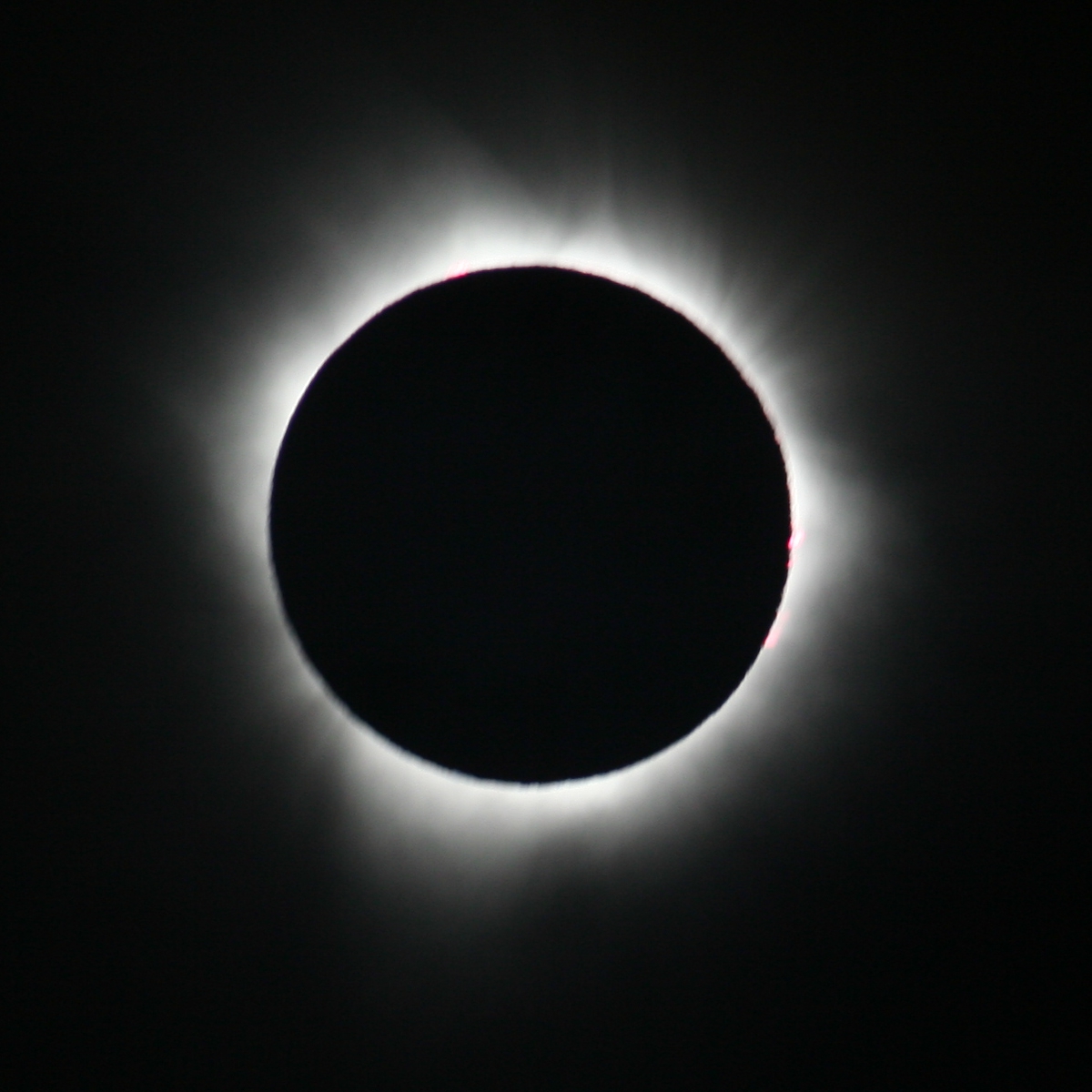
There is a solar eclipse tomorrow, so obviously I have been pondering whether some coincidences in nature require explanation, how do we know which do, and what this means for scientific theories.

Eclipses occur throughout the Solar System, and indeed wherever there are planets that have satellites like our Moon orbiting around other stars. But on Earth, the apparent size of the Moon is about the same as the apparent size of the Sun. The Sun is obviously much more mega huge than the Moon, but it is also much farther away. By some cosmic coincidence, both of these ratios are 400, resulting in a Sun and Moon that appear the same size, giving them roughly equal importance in our mythic imagination.


Does this coincidence require a scientific explanation? Is there some physical process which can explain why these two numbers are the same, or is it down to statistics?

Let me give another example. The Moon both orbits around the Earth and rotates about its own polar axis, just like the Earth both revolves around the Sun once per year and rotates once per day. But for the Moon, these periods are the same: it rotates at the same speed which it orbits the earth, with the result that one side of the Moon always faces Earth, and we can never see its far side from the Earth's surface. When I first learned about this "coincidence" I thought, what are the chances?

But there is a physical explanation for why the orbital speed and rotational speed of the Moon are the same, and it's called tidal locking. There are other tidally locked systems in our Solar System, and once we figured out the subtler implications of Newtonian gravity and celestial mechanics, science could provide an explanation for this apparent coincidence. (1 point for Science!)

Another example involves the Universe itself. As the Universe evolves and expands, the densities of matter and radiation in the Universe decrease, but the density of radiation decreases faster. In the early Universe, the density of radiation was higher than matter, but most of the time the Universe has been matter dominated -- that is, until very recently, when the Universe began accelerating. We don't know what the "dark energy" causing this acceleration is, but the simplest explanation gives it a density that is constant over time (unlike matter and radiation whose densities decrease). But why is this period of acceleration happening so close to now, when we are able to observe it? This is called the cosmic coincidence problem, and in general any successful theory of dark energy is expected to explain it, though many theories ignore it. (1 point for WTF Is Going On, Nature?)


So, what is it about these coincidences that they require physical explanation? If the phenomenon of tidal locking didn't result from our theories of gravity, would we still be searching for an explanation of why the orbital period and rotational periods of some satellites are the same? What if only our Earth-Moon system had this property? (I realize I am mostly asking questions here, not answering, but I am doing philosophy. Abandon Certainty with me for a bit.)

I have the feeling that if only the Moon had the same orbital and rotational period in our Solar System, and if gravity offered no scientific explanation, we would still be looking for some way to explain the coincidence, either scientifically or statistically. It would be too special, and too human-centric. "Because humans are special" lacks explanatory power, and since the Copernican revolution, any scientific explanation which puts humans in a special place is met with great skepticism. This is the heart of why the cosmic coincidence problem is troubling, and why some scientists would rather believe that multiple universes exist than that we occupy a special place in our own.

The eclipse coincidence -- that the Sun and Moon have the same angular size from Earth -- strikes me as similarly human-centric. But there is no physical explanation, and scientists aren't actively searching for one. I say scientists because people are certainly putting explanations out there on the internet (you see, it was necessary for the development of consciousness...), but as long as two unrelated things have happened at the same time, people have come up with explanations. Human brains are great at finding patterns, even when they don't exist.

That is not to say that scientists don't think about it. I mean, the Sun and the Moon have the same apparent size, isn't that cool?? But it's generally accepted that there is no underlying physical explanation, that the coincidence is purely statistical. Unlike with tidal locking, other celestial bodies in our Solar System don't have this apparent size coincidence, so any physical explanation would have to be unique to the Earth-Moon system. Further, the Moon is actually receding away from us (at the whopping speed of 4 centimeters per year), so in the past it appeared bigger than the Sun, and in the future it will appear smaller. Even today, the Moon actually changes its apparent size as it moves through its elliptical orbit. Given the billions of stars in our Galaxy, and the thousands of planets in other solar systems (just that we're aware of), it's likely that this apparent size coincidence is not unique.

Where does that leave our understanding of the explanation of coincidences? I have presented three examples:
  1. The Sun and Moon are observed to have the same apparent size viewed from the Earth. This can be explained statistically: given enough planetary systems, such a coincidence can be expected.
  2. The Moon has the same orbital and rotational period. There are many examples of this type of coincidence in our Solar System, and it can be shown to follow from laws of nature
  3. The acceleration of the expansion of the Universe started relatively recently in its cosmic history, which seems to place humans in a special time. Both scientific and statistical explanations are being sought: either the coincidence will be explained by a theory of dark energy, or there are so many universes that such a coincidence can be expected in one of them (ours).
So some apparent coincidences turn out to follow from a fundamental law -- to put it in fancy philosophical language, the explanandum has an explanans which is nomological -- and some can be explained statistically instead of nomologically. Does that mean all coincidences require explanation? Either they are the result of a physical law, or they have a non-zero probability of occurring, and both count as explanation? Maybe this is because of my pattern-seeking human brain, but the statistical type of explanation does not seem fulfilling to me.

More importantly, what is the probability that I will wake up in time for the eclipse tomorrow AND that there will be clear skies, given that I live in England AND I hate mornings? Such a confluence of events would be rare indeed.

Tuesday, October 14, 2014

Ada Lovelace Day: On Role Models for Women in Science

Today, October 14, is Ada Lovelace Day. You have probably never heard of her (I hadn't before last year's Ada Lovelace Day), but she is often referred to as the first computer programmer. She was born Ada Gordon but had the good fortune of being married to an aristocrat named King who became the Earl of Lovelace, and so she became Lady Ada King, Countess of Lovelace. She lived in the mid-1800s, a time when people could have names out of fairytales, but even women of means were rarely educated.

Ada Lovelace Day was started a few years ago to celebrate the achievements of women in science, technology, engineering, and mathematics (singular), commonly taken together as STEM fields. Women are underrepresented in these fields, and though there has been progress, it is frustratingly slow. And in this progress, white women are outpacing women of color. It is often thought that we need only wait until the old, white sexists in these fields are replaced by a younger more progressive population, but that expresses a complete misunderstanding of the causes of the disparity. Plus, I can tell you from experience that the younger scientific community still has a long way to go before becoming "progressive" on these issues, women included.

What are some of the causes, if not old white sexists? The Finding Ada site sums it up:
The reasons for this inequality are many, spanning issues such as social pressure on girls and women to pursue “suitable” careers, subtle misogyny in higher education and the workplace, and a lack of support for women who wish to have a family or re-skill when re-entering the workforce after having a family.
I agree generally, and though of course old white sexists do have their role in preventing the advancement of women (and not just in STEM fields), I tend to think of it as primarily the result of stereotypes. In cultures/countries where the stereotype that men are better at science and math doesn't exist - such as Italy, apparently - the representation of women is more balanced, or even skewed toward women. However, even in fields like nursing where the stereotype works toward the underrepresentation of men, the representation of men increases as you go up the career ladder (I saw this in a talk so can't reference the data); there is still the stereotype that men are better leaders and managers, which benefits the advancement of men over women even in female-dominated careers.

So, stereotypes are evil and allow people to make mental shortcuts, which affect their judgment even in the face of contradictory objective data (read "Thinking, Fast and Slow" by Daniel Kahneman). What do we do about it? Ada Lovelace Day is about doing something positive by raising the profiles of women in science and stressing the importance of role models. People are encouraged to blog about women in STEM that they admire and participate in various events, online and in person.

But when I think about what inspired me to become a scientist/astronomer/astrophysicist/cosmologist (all of which apply to me, listed in decreasing order of the representation of women), I don't think role models ever played an important role (cheeky wink!) in my career choices at all. Perhaps the lack of female role models never bothered me personally because I was a tomboy and played sports, and if anyone ever said boys were better at something, I would probably reply "nuh uh!" Perhaps it is because I was blessed with the naive sense that I can do anything because I'm good at everything, which stuck with me until grad school. Even so, I remember trying to learn about astronomy in the career center and thinking, "That seems cool, but I don't want to be an astrophysicist, that sounds much too hard." Who knows what having a role model in science could have done. I do remember having a couple of great female science teachers.

After facing the realism in grad school that I'm not better than everyone (and that that's okay, that doesn't make me the worst), I didn't exactly have many female astronomers or physicists to look up to. The lone female tenured astronomy professor in my department was a hard ass that never seemed to support women (or anyone); but I was educating myself about "diversity" issues in science and learned that it's common for older women who achieved success in a much harsher climate to avoid anything to do with "women in science" as a survival mechanism. Plus, the women I saw (and continue to see) invited to give talks at conferences are all too awesome; but this can also be explained by sociological research.

First, girls at various stages in education out-perform boys, even in stereotypically male subjects such as science and math. In college, the representation of women in these fields starts to fall, and this continues to fall at each successive stage (graduate school, postdoc, professor), a phenomenon known as the leaky pipeline. So, first assume that male and female ability is equal (even if there is evidence that girls outperform boys): when women self-select out of the field, either because of social pressure (perhaps seeing chemistry as a more friendly environment than physics) or whatever reason, the women who stay are more likely to be at the top of the ability curve. There is a biased selection effect, something which astronomers should be familiar with. When there are barriers to advancement, the super awesome women make it, while the average men make it, resulting in a pool of female role models that doesn't reflect the average a few stages back in the pipeline. (This is also a reason why striving for a percentage of female invited speakers, for example, that matches the representation in the field (which is less than 50%), is misguided: there is evidence that women are MOAR AWESOME, so invite MOAR WOMEN!)

Secondly, throwing female role models at the problem might not be all it's cracked up to be. I can't find the reference so it may not be true, but I remember hearing that role models can have a negative impact: when the role models are too few or too awesome, it can be hard for younger people to identify with the supposed role model. Perhaps I remember this because I often don't feel awesome and don't see myself in the small pool of women cosmologists who are awesome and give ALL the invited talks. (As I said above, we could do with inviting MOAR WOMEN, not just the big wigs everyone knows about!) But there could be other issues with the role model solution: this study finds that both women and men are equally beneficial as role models for recruitment (contrasted with the benefits of women for retention), and another study "suggests that role models whose success seems unobtainable can make young students feel threatened rather than motivated" (which may support my "role models too awesome" theory). Just being female and being successful in STEM may not be enough to inspire aspiring young girls. 

None of this should be taken to mean that I don't support Ada Lovelace Day. It is a great chance to celebrate the achievements of women in STEM fields, and I've learned some interesting things already. But I remain unconvinced that role models are the solution many think they are, both from my personal experience and from a few snippets of sociological research I just dug up and half-remember. And when it is seen as a magical cure-all, it over-taxes the few women who have made it to senior positions in STEM, who, as one male said in a women in science meeting, need to "step up" and take on more responsibility, with no hint of irony at all.