Today on arXiv I came across a paper about a model of the Universe called "chaotic cyclic cosmology" and wondered, what motivates people to come up with crazy models like this?
Perhaps because it is fun.
The many unsolved problems of cosmology make a lot of crazy sounding models possible. Sure, maybe they are unlikely, but if you can take yourself out of the equations a bit and think about what it means that they allow "eternally bouncing models to occur" - actually try to picture in your head an eternally bouncing universe - well, that is just fun.
As a scientist, at some level you have to enjoy the day-to-day - writing code, solving equations, analyzing data, reading and writing papers - but sometimes it can be tedious, dull, and lifeless. Analytical thinking requires dissecting a problem, cutting it apart and studying its pieces as it lies cold and dead upon the operating table of your mind... While getting lost in the details of problem solving and figuring out all the minutia are good for science, they are not necessarily good for your psyche.
To all scientists out there: the next time you are working on that minor contribution to science, struggling to put that next brick in the wall of human knowledge, I think it is worth it to remind yourself occasionally that
the subject of your studies is the Universe and the Universe is awesome.
[Non-cosmologists have to substitute "the Universe" for their own
subject, but as constituents of the Universe, those things are awesome
too.]
To all non-scientists: the next time you get tired of doing whatever it is that you do, ask a scientist to explain their work to you so you both get a boost from thinking about how awesome the Universe is.
Showing posts with label Awesomeness. Show all posts
Showing posts with label Awesomeness. Show all posts
Wednesday, November 11, 2015

Wednesday, April 1, 2015
It's Okay to Be a Fool
I don't like doing April Fools' Day pranks, and (or because?) I don't like getting pranked. If I think about it, it's probably some social anxiety related fear of looking stupid in front of people. But honestly, most April Fools pranks involve straight up lying to people, and if they believe the lie they are a "fool". HAHA?
But maybe it's good to have one day a year where it is okay, even expected, to be a fool. To not take things so seriously. You thought something was true and you were wrong, but laugh about it, it's aight! You can't trust people, even friends and family, to be straight with you and not lie to your face for a laugh at your expense.... ain't life a hoot!
Life is absurd.
April Fools' Day is a good day to celebrate being silly and, if you can manage it, not giving a shit what people think. Kids are good at this, but at some point we learn to worry about being judged for not behaving "appropriately" i.e. like somber Adults. Eff that. Being an adult is overrated. One of the things I love about playing with my niece and nephew is doing silly shit and not caring because a kid is making me do it, that's how it works. If you don't make a fool of yourself in front of a baby that baby will be unimpressed. (And will miss out on working their face muscles trying to imitate you? That is a plausible theory, someone should look that up...) That baby wants you to be a fool and will reward you with a smile.
The interesting thing I learned from the internet today is that April 1 used to be when people celebrated the New Year. A possible origin of April Fools' Day is that when New Year's Day was changed to January 1, some people either didn't hear about the change (there was no internet back then) or refused to move their day of celebration, so they were made fun of. New Year's on April 1 is kind of great though (for the Northern hemisphere anyway): it's Spring! Things are new! Plants and animals that hibernated over winter are coming back to life! Gods are resurrected! Eggs and bunnies! The Chinese New Year also marks the beginning of Spring. What better time to celebrate newness than when things are new?
And since I brought up symbols (gods and eggs), let's look at the symbolism of the Fool. Or rather, let's watch Joseph Campbell talk about the Trickster god in Native American mythology who "represents the power of the dynamic of the total psyche to overthrow programs." The great thing about the Fool character/archetype (and of course I first learned this from Campbell's "The Power of Myth" special) is that he's "both a kind of devil and fool and the creator of the world" who "breaks through the notion of what a deity ought to be."
And of course, breaking through the notion of what a deity ought to be is important because our idea of God, and its many images and manifestations, is just a symbol, a mask of eternity. It is not eternity itself. If you forget that, the Trickster will fuck with you.
So, folks, it's okay to be a fool. God is a fool, and you are god too.
Happy New Year!
Wednesday, January 29, 2014
A new/old supernova/star is born/dead
If this were a science blog, I would be all over the discovery of a Type Ia Supernova in a very nearby galaxy. I mean, I used to work on Supernovae Ia! Though the ones I studied were admittedly very far away... and though they were admittedly only simulated, i.e. not real at all... well, after I simulated them I treated them as real... but what does "real" even mean in this sense? How are data points from a "real" supernova different than data points from a simulated one? What is the ontology of simulation?
Where was I?
Oh yes, that's right: "Woohoo! This is a cool thing for science!" is something I would be saying if this were a science blog. I would talk about how close the supernova is, using analogies that would help you understand how something incredibly far away is practically next door on the scale of THE UNIVERSE. (It's so close the galaxy is a Messier object, M82, with a name, the "Cigar Galaxy.") But others are doing that. I'm more interested in how contemplating the scale of THE UNIVERSE can make us feel simultaneously very small and very important.
I mean, we, as human beings, are already an unimaginably small dot on the Earth which is incredibly tiny compared to our Sun, not to mention the vast emptiness of space that separates the Earth from the Sun, which, cosmologically speaking, is practically buzzing with debris and not empty at all... and of course, cosmologically speaking, the Sun doesn't even register as an infinitesimally small speck in a mediocre galaxy in the unfathomable hugeness of space. It takes light a mere 8 minutes to reach us from the Sun, but light from this new supernova has been traveling to us for 11.4 million years! And it is a nearby event! The star died 11.4 million years ago, and the supernova explosion marking its death happens on the scale of a month. And here we are to observe it, sitting on our planet in a nearby galaxy, focusing our prisms and mirrors on this awesome event, cozy with our blankets and hot chocolate (stay warm, USA) in the knowledge that our Sun won't die on us for at least another 5 billion years.
I might talk about how the news is making some of my colleagues as excited as kids in a candy shop. There is so much astrophysical data and in so many colors! (That is an Astronomy joke, by the way. Feel free to laugh.) And I would show some pretty pictures, if this were a science blog, for sure. Wait, I can still do that... hold on... there:
If this were a science blog, I could talk about how it's so bright, and getting brighter still, that anyone with access to clear skies and small telescopes can see this new point of light for themselves. But others are doing that too. And I'd rather imagine what it might be like, looking through an eyepiece up into the sky at a dying star in another galaxy... sure, the image itself might not be spectacular, but knowing what it is brings so much more.
I have a small telescope, and I've seen Jupiter and its moons. But without that knowledge, all you can see is a smallish dot with a few smaller dots around it sort of along a straight line, and if you're lucky, the biggest smallish dot has some dark lines across it. The experience is less meaningful if you don't know that you're looking at another planet, which is very big and very far away. I don't mean knowing the names of Jupiter and its moons, or how far away they are, or any details like that, is important... but looking at Jupiter, or this new supernova, without knowing its place in the pattern is like seeing a puzzle piece without any picture on it - basically, meaningless. And that is the magic of learning, and of science - turning a bunch of pieces of a puzzle into a beautiful picture, or even an ugly picture when you get down to it, but a picture nonetheless of something you understand. I would even say that understanding by itself is beautiful, and that understanding something ugly turns it into something beautiful - not beautiful in the sense of aesthetically pleasing, but in a larger meaning - whole and right and beautiful. Of course, I can say all of that because this isn't a science blog.
If it were, I would talk about how this particular type of supernova was responsible for the discovery that the expansion of the universe is accelerating, and how this messes with our understanding of cosmology in a fundamental way. Actually, I might write about that one day... but this supernova is so close, it's unlikely to answer those fundamental questions.
What I would really talk about, if this were a science blog, is how this particular type of supernova is responsible for the creation of all heavy elements, without which life as we know it would not be possible. You may have heard that "we are made of star stuff" because of the creation of all elements heavier than Helium (and trace Lithium) in the nuclear furnaces of stellar cores. (Or you might have heard that "if you wish to make an apple pie from scratch, you must first invent the Universe.") But all elements heavier than iron (and most of the iron) can only be created in the special conditions of a stellar death - the massive energy of a star collapsing in on itself and exploding in a supernova. Of course, I would check all of my facts before saying things like that, if this were a science blog.
I would focus on the creation of heavy elements because this supernova is the perfect metaphor for the un-metaphorizable, the awe and the awesome, the "Tao" or "Brahman" or "whatever, none of that is real" or whatever you want to call it. It is creation and destruction at once: the creation of the possibility for life, as the elements in its ejecta travel out to one day find their way into new stars of their own - or possibly into the planets around that star and eventually the life on those planets; but also, it is the destruction of the possibility for life as the death of a life-giving star itself. In order for there to be life, there has to be death, in the heavens as it is on Earth.
Amen.
Where was I?
Oh yes, that's right: "Woohoo! This is a cool thing for science!" is something I would be saying if this were a science blog. I would talk about how close the supernova is, using analogies that would help you understand how something incredibly far away is practically next door on the scale of THE UNIVERSE. (It's so close the galaxy is a Messier object, M82, with a name, the "Cigar Galaxy.") But others are doing that. I'm more interested in how contemplating the scale of THE UNIVERSE can make us feel simultaneously very small and very important.
I mean, we, as human beings, are already an unimaginably small dot on the Earth which is incredibly tiny compared to our Sun, not to mention the vast emptiness of space that separates the Earth from the Sun, which, cosmologically speaking, is practically buzzing with debris and not empty at all... and of course, cosmologically speaking, the Sun doesn't even register as an infinitesimally small speck in a mediocre galaxy in the unfathomable hugeness of space. It takes light a mere 8 minutes to reach us from the Sun, but light from this new supernova has been traveling to us for 11.4 million years! And it is a nearby event! The star died 11.4 million years ago, and the supernova explosion marking its death happens on the scale of a month. And here we are to observe it, sitting on our planet in a nearby galaxy, focusing our prisms and mirrors on this awesome event, cozy with our blankets and hot chocolate (stay warm, USA) in the knowledge that our Sun won't die on us for at least another 5 billion years.
I might talk about how the news is making some of my colleagues as excited as kids in a candy shop. There is so much astrophysical data and in so many colors! (That is an Astronomy joke, by the way. Feel free to laugh.) And I would show some pretty pictures, if this were a science blog, for sure. Wait, I can still do that... hold on... there:
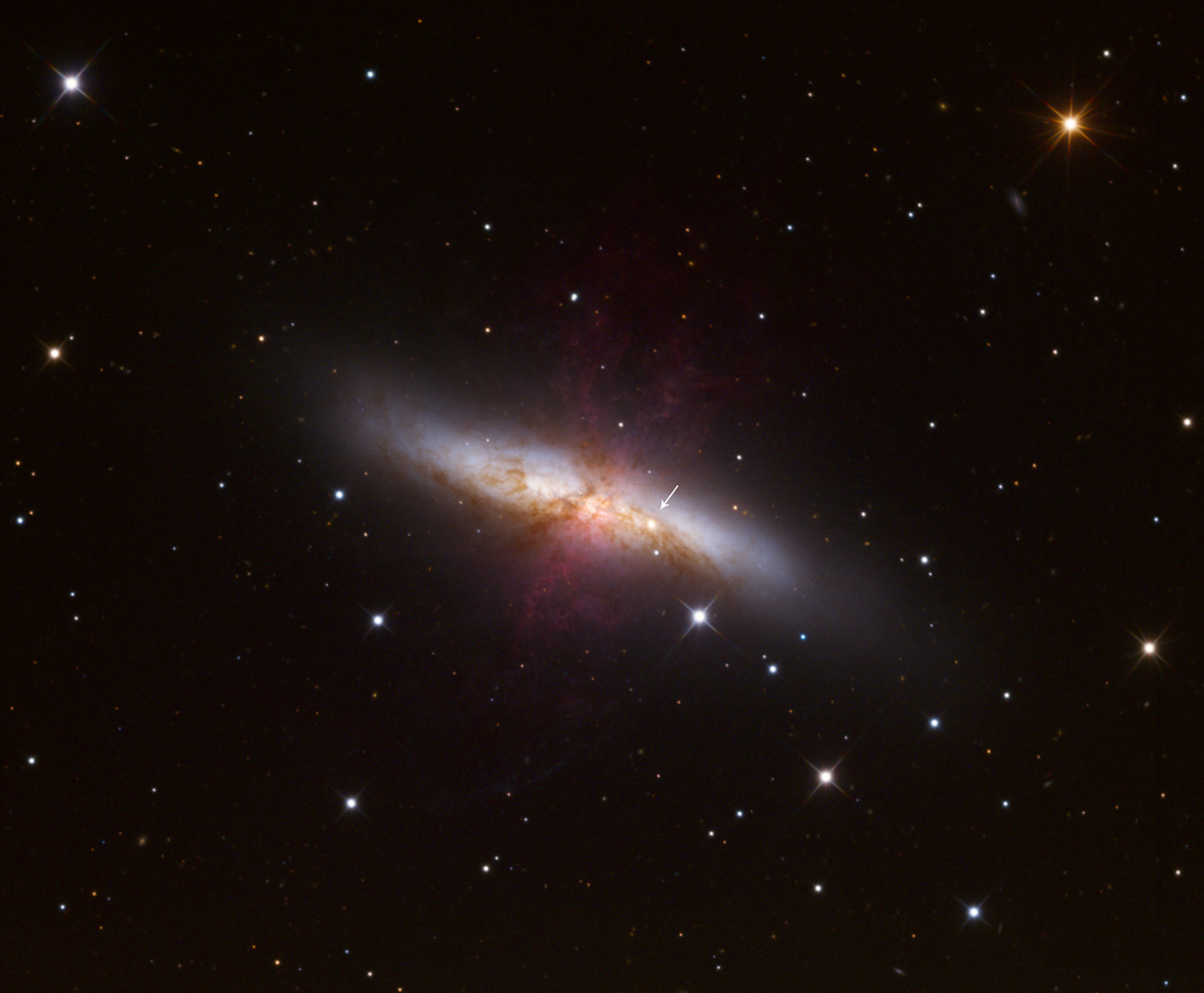 |
| From Astronomy Picture of the Day; Image Credit & Copyright: Adam Block, Mt. Lemmon SkyCenter, U. Arizona |
If this were a science blog, I could talk about how it's so bright, and getting brighter still, that anyone with access to clear skies and small telescopes can see this new point of light for themselves. But others are doing that too. And I'd rather imagine what it might be like, looking through an eyepiece up into the sky at a dying star in another galaxy... sure, the image itself might not be spectacular, but knowing what it is brings so much more.
I have a small telescope, and I've seen Jupiter and its moons. But without that knowledge, all you can see is a smallish dot with a few smaller dots around it sort of along a straight line, and if you're lucky, the biggest smallish dot has some dark lines across it. The experience is less meaningful if you don't know that you're looking at another planet, which is very big and very far away. I don't mean knowing the names of Jupiter and its moons, or how far away they are, or any details like that, is important... but looking at Jupiter, or this new supernova, without knowing its place in the pattern is like seeing a puzzle piece without any picture on it - basically, meaningless. And that is the magic of learning, and of science - turning a bunch of pieces of a puzzle into a beautiful picture, or even an ugly picture when you get down to it, but a picture nonetheless of something you understand. I would even say that understanding by itself is beautiful, and that understanding something ugly turns it into something beautiful - not beautiful in the sense of aesthetically pleasing, but in a larger meaning - whole and right and beautiful. Of course, I can say all of that because this isn't a science blog.
If it were, I would talk about how this particular type of supernova was responsible for the discovery that the expansion of the universe is accelerating, and how this messes with our understanding of cosmology in a fundamental way. Actually, I might write about that one day... but this supernova is so close, it's unlikely to answer those fundamental questions.
What I would really talk about, if this were a science blog, is how this particular type of supernova is responsible for the creation of all heavy elements, without which life as we know it would not be possible. You may have heard that "we are made of star stuff" because of the creation of all elements heavier than Helium (and trace Lithium) in the nuclear furnaces of stellar cores. (Or you might have heard that "if you wish to make an apple pie from scratch, you must first invent the Universe.") But all elements heavier than iron (and most of the iron) can only be created in the special conditions of a stellar death - the massive energy of a star collapsing in on itself and exploding in a supernova. Of course, I would check all of my facts before saying things like that, if this were a science blog.
I would focus on the creation of heavy elements because this supernova is the perfect metaphor for the un-metaphorizable, the awe and the awesome, the "Tao" or "Brahman" or "whatever, none of that is real" or whatever you want to call it. It is creation and destruction at once: the creation of the possibility for life, as the elements in its ejecta travel out to one day find their way into new stars of their own - or possibly into the planets around that star and eventually the life on those planets; but also, it is the destruction of the possibility for life as the death of a life-giving star itself. In order for there to be life, there has to be death, in the heavens as it is on Earth.
Amen.
Monday, May 20, 2013
Nautilus
I'm in love with this new magazine, Nautilus. It is named after "a remarkable intersection of science, math, myth, and culture", a mollusk with a fractal logarithmic spiral in its shell. First of all, I love logarithms! In a weird cosmic synchronicity, the random (from a list of names?) band name given to me in Rock Band was "Just a Matter of Logarithms" and you'd better believe I kept it. Second of all, I love science, math, myth, AND culture! I love all of those things! So I was pretty excited to find out about this magazine.
The first article I read, I chose because of the title, "Metaphors Are Us". (I love metaphors!) I was fascinated to find out how metaphors, empathy, morality, and neurology all come together in a beautiful and complicated mess of humanity. Our ability to feel empathy, to connect to someone else's pain and feel it ourselves, relates to very specific functions of the brain:
I haven't finished Issue 1 yet because I was distracted by Issue 0, which I got around to reading today. I probably won't write about all of the issues, but here are more reasons I love Nautilus:
In one article, I learn that music is fractal, and so is a coastline!A fractal pattern looks the same on large scales as it does on small ones; put another way, the parts of a fractal system look similar to the entire system. I'm not entirely sure how music is fractal, but it's still cool!
In another article, I get some fascinating insight into psychological epistemology:
So anyway, this is very fascinating for psychological epistemology: the easier something is for us to understand, the more likely we will accept it as true. Simple and elegant solutions just seem right. Things that don't make "horse sense" are met with skepticism. And when we hear something over and over again it becomes much easier to believe, even when it has no relation to reality. (I'm glaring meaningfully in your direction, Fox "News"....)
A third article had me at its title, "Where Science and Story Meet", because I've been wanting to read "The Storytelling Animal" but it's not at my local bookstore. The article was not quite what I expected, but that's good; if I only ever learned what I expected to learn, then I probably wouldn't actually learn very much. Anyway, the unexpected thing I learned was that
There's more Nautilus to read, and learn and think about, but this story is over for now!
The first article I read, I chose because of the title, "Metaphors Are Us". (I love metaphors!) I was fascinated to find out how metaphors, empathy, morality, and neurology all come together in a beautiful and complicated mess of humanity. Our ability to feel empathy, to connect to someone else's pain and feel it ourselves, relates to very specific functions of the brain:
While in a brain scanner, you’re administered a mild shock, delivered through electrodes on your fingers. All the usual brain regions activate, including the anterior cingulate. Now you watch your beloved get shocked in the same way. The brain regions that ask, “Is it my finger or toe that hurts?” remain silent. It’s not their problem. But your anterior cingulate activates, and as far as it’s concerned, “feeling someone’s pain” isn’t just a figure of speech. You seem to feel the pain too.Humans also appear to abstract disgust as well as pain. The insula, which processes gustatory disgust in all mammals (to make us spit out poison, for example), also activates when we think about some shameful thing we did. This "moral disgust" also relates to humans as social creatures:
Many cultures inculcate their members into acquiring symbols that repel, doing so by strengthening specific neural pathways from the cortex to the insula, pathways that you’d never find in another species. Depending on who you are, those pathways could be activated by the sight of a swastika or of two men kissing. Or perhaps by the thoughts of an abortion, or of a 10-year-old Yemeni girl forced to marry an old man. Our stomachs lurch, and we feel the visceral certainty of what is wrong. And we belong.That beautiful paragraph makes me want to read more by the article's author, Robert Sapolsky.
I haven't finished Issue 1 yet because I was distracted by Issue 0, which I got around to reading today. I probably won't write about all of the issues, but here are more reasons I love Nautilus:
In one article, I learn that music is fractal, and so is a coastline!A fractal pattern looks the same on large scales as it does on small ones; put another way, the parts of a fractal system look similar to the entire system. I'm not entirely sure how music is fractal, but it's still cool!
In another article, I get some fascinating insight into psychological epistemology:
According to Rolf Reber, a psychologist at the University of Bergen, in Norway, “there is growing empirical evidence that people use a common source for evaluations of both beauty and truth.” The source he refers to is processing fluency, the state of being able to easily parse and understand a situation. Essentially, the more easily we can get a handle on a situation (because it’s mathematically simple, we’ve seen it many times before, it’s symmetrical, etc.), the more likely it is to seem right.This explains so much about people and why they believe what they do! (I have just now decided to call this psychological epistemology. It probably already has a more appropriate and boring name like the "psychology of belief" but... boring.)
So anyway, this is very fascinating for psychological epistemology: the easier something is for us to understand, the more likely we will accept it as true. Simple and elegant solutions just seem right. Things that don't make "horse sense" are met with skepticism. And when we hear something over and over again it becomes much easier to believe, even when it has no relation to reality. (I'm glaring meaningfully in your direction, Fox "News"....)
A third article had me at its title, "Where Science and Story Meet", because I've been wanting to read "The Storytelling Animal" but it's not at my local bookstore. The article was not quite what I expected, but that's good; if I only ever learned what I expected to learn, then I probably wouldn't actually learn very much. Anyway, the unexpected thing I learned was that
The pleasurable feeling that our explanation is the right one—ranging from a modest sense of familiarity to the powerful and sublime “a-ha!”—is meted out by the same reward system in the brain integral to drug, alcohol, and gambling addictions.Not only are humans good at pattern recognition, but figuring out the pattern produces happy chemicals in the brain! Solving that equation, putting that jigsaw piece in the right place, or hearing someone else tell you something you already know is true - putting things together into a coherent story - makes us feel good, while not solving that equation or puzzle, or having a friend present you with facts that contradict your beautiful story, makes us hate math and angry at our friends. This pretty much explains why I like to do jigsaw puzzles when I'm stressed, and adds to theories I have about the psychology of gaming. (Or maybe theories other people have that I've read...)
There's more Nautilus to read, and learn and think about, but this story is over for now!
Monday, November 26, 2012
Life
On the Friday after Thanksgiving my niece Autumn Rayne was born. I think she has my eyebrows, or at least my default cynical expression.

But maybe I am just looking for things that aren't there.
There are a million things I could wax philosophical about at this point. Life! There is a new person in the world! Although she is currently spending her time sleeping, peeing, and sucking, she will be rapidly learning new things in the near future... smiling! holding things! What wonders the world will bring!
There are a million things I could ruminate about, including how frustrating it is to be 5 time zones away, but I keep thinking about death. When I waxed philosophical about (mostly metaphorical) death it was to stress that without death there would be no life, because there would be no change. But that doesn't seem to work the other way around... it is not useful nor wise to think about life in terms of death. Life is the upswing, the start, the beginning of growth. Life speaks for itself, but death cannot. Life needs no explanation because life is.
Just a few days ago Autumn was safe inside her mother's womb. Things won't be so easy from now on. She will have to confront a steady stream of things-she-can't-do, one by one, and turn them into things-she-can-do. She will have 4 older brothers, 2 crazy aunts, and every toy and piece of clothing she will get for the next 10 years will be pink. What if she doesn't like pink? Let's just hope that she does!
New life means endless uncertainty. (Some good and some bad.) There is no limit to what she could do or be and we are free to speculate that it will all be awesome. And why not?
Welcome to your life, Autumn.
Tuesday, June 5, 2012
Transitory
Today Venus will transit the Sun (i.e. pass in front of it for our viewing pleasure). There are a lot of things that could be said about this event and it is certainly a great opportunity for astronomical public outreach. Locally we will have a bunch of telescopes for public viewing, starting with talks by both Nobel Laureates and scientists who actually study transiting planets.
But the Deep Thought I have been struck by is how a lot of the attention is focused on how this is the "Last Transit of Venus any of us will see in our lifetimes" (as the announcement e-mail of our own outreach event states). Where was all the hubbub during the 2004 transit? Obviously that wasn't as cool. Venus must always be transiting the Sun if there's another event in 8 years. But now, it's the Last Chance. If you don't see it now you won't have another chance because you will be dead!
I think this is an example of a common phenomenon. Things that happen all the time are boring. Things that happen rarely are much more interesting. Things that will only happen one more time before you die are even more awesome and I don't think it's because of a morbid fascination with our own mortality, but rather a life-affirming fascination with our own mortality.
Transitory events remind us of our own transitory-ness and that Hey, we better start paying attention to things while we still can! The universe is a fascinating place in which Cool Things Happen instead of a boring place in which nothing changes! Sweet!
So I hope you enjoy it along with all the other things happening in this transitory event called Life.

Tuesday, May 8, 2012
I just want to feel everything
When I need to sing, I listen to Fiona Apple. By now I have mostly memorized her first two albums (3rd was less impressive) - not only is she awesome, but she sings in my range and with such emotion, and when I need to sing, it is usually related to emotions. So I was excited to hear her new song, Every Single Night, which is particularly awesome and which prompted me to get tickets to her show (and I never go to shows). I like the sparsity of the instrumentation, the accents of percussion, and the sudden fullness of vocals when she sings "brain" in the chorus. This was a new Fiona Apple and I was very excited.
And then I read the lyrics! It turns out that this song expresses much of my life. From worrying way too much about what other people are thinking, to not being able to go to sleep unless I can distract myself from the constant barrage of my thoughts, to "I just want to feel everything."
In the song, this is first expressed in terms of a curse or a burden. "The pain comes in" and "I can't fit the feelings in. Every single night's alight with my brain." Then, "my breast's gonna bust open... I just made a meal for us both to choke on. Every single night's a fight with my brain." Opening yourself up to the multitude of feelings, the immensity, is a difficult and painful process. Most of the time when I realize what I'm doing (worrying) I wish it would stop, but it doesn't. So I fight with my brain and continue to worry, and try to go to sleep.
But after a while, "maybe I'd relax; let my breast just bust open. My heart's made of parts of all that surround me... Every single night's alright..." This acceptance of the abundance of feeling occurs much less often than the worrying. Even though I identify with the concept of opening the heart (chakra) and feeling everything, it is not a sustainable state of being. You can't experience the "pure being ball thing" all the time, and so you get swept back into the drama of human suffering - or what I like to call being alive. So it is fitting that what the phrase "I just want to feel everything" reminds me of is when the souls in the Golden Compass trilogy finally die:
What I wouldn't give to embrace the whole universe. If that only happens when you die, then that is my version of heaven. I just want to feel everything!
And then I read the lyrics! It turns out that this song expresses much of my life. From worrying way too much about what other people are thinking, to not being able to go to sleep unless I can distract myself from the constant barrage of my thoughts, to "I just want to feel everything."
In the song, this is first expressed in terms of a curse or a burden. "The pain comes in" and "I can't fit the feelings in. Every single night's alight with my brain." Then, "my breast's gonna bust open... I just made a meal for us both to choke on. Every single night's a fight with my brain." Opening yourself up to the multitude of feelings, the immensity, is a difficult and painful process. Most of the time when I realize what I'm doing (worrying) I wish it would stop, but it doesn't. So I fight with my brain and continue to worry, and try to go to sleep.
But after a while, "maybe I'd relax; let my breast just bust open. My heart's made of parts of all that surround me... Every single night's alright..." This acceptance of the abundance of feeling occurs much less often than the worrying. Even though I identify with the concept of opening the heart (chakra) and feeling everything, it is not a sustainable state of being. You can't experience the "pure being ball thing" all the time, and so you get swept back into the drama of human suffering - or what I like to call being alive. So it is fitting that what the phrase "I just want to feel everything" reminds me of is when the souls in the Golden Compass trilogy finally die:
They... held out their arms as if they were embracing the whole universe; and then, as if they were made of mist or smoke, they simply drifted away, becoming part of the earth and the dew and the night breeze.- Phillip Pullman, The Amber Spyglass (emphasis mine)
What I wouldn't give to embrace the whole universe. If that only happens when you die, then that is my version of heaven. I just want to feel everything!
Friday, April 6, 2012
Elvish is Easy
The hardest part of writing something in Elvish is figuring out what to say.
Once you've done that, everything else just follows naturally. First, you have to see if there is a reasonable translation. (Remember, it's Elvish, there are no words for spaceship.) Obviously Sindarin is the specific language to go with, as it is the primary language of the elves in Middle-Earth (most of the high elves having gone over the sea into the West) - but if you are going to be particularly poetical or if you want to translate a wizard's spell, Quenya might be worth the effort. Either way, simply look up your words in an online dictionary (Sindarin or Quenya (pdf)) and write them down for later. This is your starting point, but if you simply string these words together you would sound like a crass dwarf. Elvish is anything but crass.
The next step is to consult this guidebook to figure out how to pluralize your nouns, conjugate your verbs, and especially how each word might be changed based on what other word is before or after, known as lenition or soft mutation. This is all really quite simple. If you want to say "friends", change the "o" in mellon to "y" and there you have it: mellyn nin, "my friends". You don't have to change the "e" to "i" because it occurs in the first syllable. If you want to say something about Ents, both "o"'s in Onod get mutated, the first to "e" and the second to "y" to get Enyd (but sometimes the first "o" is not mutated, so you will just have to know when it is right to do it). However, if you are talking about the Ents as a people, instead of just two or more Ents, you don't pluralize any vowels but instead add -rim to get Onodrim. Similarly Amon for "hill" gets changed to Emyn for "hills" as in the Emyn Muil. You get the point. Quite easy.
Now if you want to say "my friends" in the middle of the sentence instead of the beginning - such as in the King's Letter: e aníra ennas suilannad mhellyn în, "he wishes there to greet his friends" - you must add a soft mutation to change the "m" to "mh" (or usually "v", of which "mh" is a nasal variant). Most other consonants are lenited when preceded by a vowel, such as the article i meaning "the": "the friend" becomes i vellon.* Also, p, t, and c become b, d, and g while b and d become v and dh (which is voiced th), and g drops altogether as in Galadriel's opening words in the FOTR movie: a han noston ned 'wilith, "and I can smell it in the air", where the word for "air" is gwilith. This is all very straightforward. Now your set of Sindarin words may bear only a vague resemblance to the initial Sindarin words you had from the dictionary. But you probably shouldn't have tried to mutate your nouns before dealing with the verbs.
* Of course "the friends" becomes i mellyn since the plural article in triggers the nasal mutation which changes in to i before an "m", since of course "m" is already nasal, whereas in + gelaidh becomes i ngelaidh ("the trees"). Obviously.
First figure out what kind of verb you have, whether it is a derived verb (called A-stem because they end in "a"), or the more complex basic verb (I-stem because their present tense ends in "i" though they usually have no suffix), and of course notice whether your A-stem verb has a mixed conjugation or whether it is irregular. As you can see, it should be quite obvious which type of verb you have. Then simply follow the rules and conjugate to your heart's content, paying attention to the pronoun you require. So for example, the present tense of nosta- above is identical to the word itself: nosta, "smell", but to say "I smell" you add the ending -n, which changes the "a" to "o": han noston, "I smell it". This should all go without saying.
I will of course assume that you have all read the pronunciation guide in the back of The Silmarillion and have not been butchering the language by saying mae govannen as "may" instead of the correct "mai". That means it will be quite easy to take your Sindarin sentence and transliterate to one of the runic alphabets, such as the blocky Cirth preferred for stone work, and by the dwarves, or the more elegant Tengwar such as appears on the One Ring. The tengwar are created by combining telcor (stems) and lúvar (bows) based on where the sound is spoken in the mouth and whether it is voiced or voiceless (see figure). Then of course there are additional letters, which can be written both normally or upside-down, but that should pose no difficulty.

Double letters (such as "nn" in govannen) aren't written twice but are instead denoted by adding a special symbol under the letter, and nasalized letters have a symbol over the top. The vowel sounds also have their symbols placed on top (or under) the consonant preceding (Quenya) or following (Sindarin) the vowel. When there is no available consonant carrier, a special short or long carrier is used, based on whether the vowel sound should be short or long. This is all so logical that you have probably derived it from first principles already, but I mention it here for clarity.

Now all you need to do is download some true type fonts for tengwar, of which there are many. If you are going to put your Elvish phrase into your Ph.D. thesis, for example, it will also help to have a LaTeX package that will place your choice of font neatly into your pdf, and all you have to do is type out the Quenya names for all of the letters and symbols that go into your words.

There you have it. Was that so hard?
Sunday, March 18, 2012
Immensity
Merry looked out in wonder upon this strange country, of which he had heard many tales upon their long road. It was a skyless world, in which his eye, through dim gulfs of shadowy air, saw only ever-mounting slopes, great walls of stone behind great walls, and frowning precipices wreathed with mist. He sat for a moment half dreaming, listening to the noise of the water, the whisper of dark trees, the crack of stone, and the vast waiting silence that brooded behind all sound. He loved mountains, or he had loved the thought of them marching on the edge of stories brought from far away; but now he was borne down by the insupportable weight of Middle-earth. He longed to shut out the immensity in a quiet room by a fire.- J.R.R. Tolkien, "The Return of the King," p. 64
This is why I will always be reading and re-reading Tolkien. I may put LOTR away for a few months or more, but when I'm ready, I will find my bookmark and read something beautiful. I must have read this paragraph 10 times before, but this time it was new and powerful. I want to go to a mountain and listen to the whisper of dark trees! I want to listen to the vast waiting silence that broods behind all sound! And especially, I want to return from the mountains to shut out the immensity in a quiet room by a fire.
Experiences of awe such as Tolkien describes can be overwhelming; one can lose oneself in the vastness. At first this feeling can be exciting: sit on a mountain, or gaze at the stars, and you become small in relation to your experience, but at the same time you become part of the immensity itself. "Formless! Boundless!" (to roughly quote the Tao Te Ching...) You lose you to become the experience. This can be thrilling, but it can also be frightening. After all, we are used to thinking of ourselves as ourselves and not the entire universe. When Middle-earth gets too huge we look for a safe place to be ourselves again.
It takes courage to lose yourself in immensity. The deep ocean, the high mountain, the crowded city center, the vast waiting silence that broods behind all sound... Most of us don't have the time (or the will) to experience vast strangeness, like Merry on an epic journey he could not anticipate, finding himself bereft of his friends. We don't often willingly put ourselves into a situation where nothing is familiar, without guarantee of security or a safe way home again. Those who do are praised as heroes. But although we may think of a hero as an Aragorn figure with a destiny for greatness, clarity of purpose, strength and kindness and a long stride, most heroes (and most of us) are more like the hobbits, who dream of eggs and bacon and a seat by the fire, and for whom Middle-earth is best experienced through stories brought from far away; but the immensity is there for us all, waiting for us to enter.
Wednesday, September 28, 2011
Joseph Campbell and the Masks of Eternity
A while ago I was asked to blog about Joseph Campbell, and
after months of not knowing how, here it finally is. It’s hard for me to try to
condense what I understand and love about Joseph Campbell into a few ideas.
I’ve been watching The Power of Myth ever since college, after I read The
Hero with a Thousand Faces (I still have the book I “borrowed’’ from my
mom), when I saw it on TV and decided I had to buy it. I once described it as food
for the soul. So for one, it resonates with me. For another, it deals with the
human experience (as all myths do) and so it is universal and un-specific, and
thus it is hard to specify. But anyway, it’s difficult to sum up what Joseph
Campbell means to me... but this blog wasn’t created for summations that distill
great meaning into digestible portions of meaninglessness, so I will do what I
can. To not do that.
After watching the last episode of The Power of Myth, “The
Masks of Eternity,” and writing down everything awesome (which filled nearly
three pages), I am resisting the urge to quote the entire thing. But I think there
is one part where Joe explains a statue of the Hindu god Shiva which
encompasses most of the main themes he talks about.

“The dance of the world – the dancer whose dance is the Universe. In this hand he has the drum of time, which shuts out eternity, and we are enclosed in that; and in this hand a flame which burns away the veil of time and opens us up to eternity; and in his hair is a skull and a new moon, the death and rebirth at the same moment, the moment of becoming.... The goal of your quest in your life is to find that burning point in yourself, that becoming thing in yourself, which is fearless, and desireless, but just becoming.”
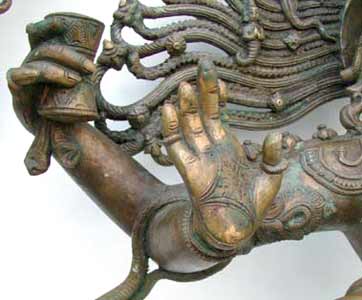 Drum of time: The
beat of the drum symbolizes time and shuts out eternity, which is timeless. Thought
is temporal. Symbols are expressions of thought. The great mystery transcends
thinking and symbols. “God is a thought – God is an idea – but its reference is
to something that transcends all thinking. It is beyond being! Beyond the
category of being and non-being! Is he or is he not? Neither is or is not.” So
the idea of God that most people have is a symbol of the eternal, but it is not
the eternal. Everything that exists, exists in the field of time, and things
like unicorns merely do not exist, but the eternal refers to the transcendence
of such dualities and is not then, or
there, but in the ever-changing moment.
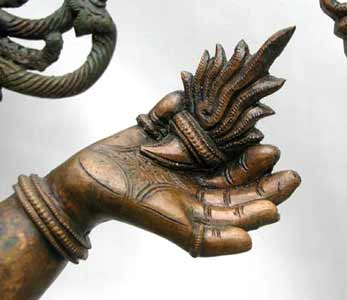 Flame of eternity: The
flame which burns away the veil of time opens us up to eternity. It is a
cleansing fire. To be open to what is instead of what you desire or what you
fear is also to give up your ego and your identification of self with your
thoughts. You are not your thoughts, and you are not your fears. This is the
experience of the sublime, which opens you, but which may be terrifying,
detaching you from what you had identified as yourself – your house, your car,
your job, your country, what you are good at, what you hate, what you find
funny – The “dismantling” process talked about in I <3 Huckabees, this is
it. You are the blanket.
Death and rebirth: In
the “moment of becoming” you have the symbols of death and rebirth, creation
and destruction, and the idea of unified duality. Duality is expressed by the
world and its opposites – being and non-being, light and dark, good and evil,
up and down, true and false – and in the unity of duality, as in the symbol of
the Yin Yang, polar opposites are understood as existing coherently and
inter-dependently – for if there were no such thing as dark, then light would
be meaningless. In one episode Joe talks about how Adam and Eve in the Garden
of Eden, the garden of unity, eat of the fruit of knowledge of the pairs of
opposites and are cast out. From Heaven to Earth truly: from transcendence to
existence. This is not to say that Heaven is a place, for that gives it the
property of existence. Heaven is an idea, whose “reference is to something that
transcends all thinking.”
 Burning point of
becoming: The statue of Shiva is understood as metaphorical, as all myths
are, of the human mystery, and so the “quest in your life” is not to worship
the god Shiva but to find the Shiva-ness in yourself that is “desireless and
fearless.” The hero’s journey is a symbolic undertaking that represents this
quest: the hero leaves the world of the known to obtain rejuvenating life for
the community. The hero finds and brings back fire, dies and is reborn, kills
the dragon, becomes enlightened... but myths, religions, and rituals can be
understood in terms of the hero’s journey because the hero is a symbol of you, and his journey symbolizes your life. “Have you died to your animal nature and been reborn?” Have you killed your dragon of ego and greed?
Well, how do you do that? Find that point of fire within
yourself: “Follow your Bliss.” (Or, as he later remarked, follow your
blisters.) This is not what makes you happy but what makes you energized, or
makes you “feel the rapture of being alive.” It increases the awesome and decreases the suck. It is the immovable center, the
eternal, the God, that is in you. It
is your hero quest and your great adventure. For Joseph Campbell, his Bliss was
in the study of mythology. Sometimes mine is writing this blog. However:
“Words are always qualifications and limitations, and that’s why it’s a peak experience to break past all that, every now and then, to realize: ‘Oh, ah.’ I think so.”
As do I, Joseph Campbell. As do I.
Thursday, August 25, 2011
Nature's Wrath
I woke this morning to the sound of thunder. As my alarm was about to go off anyway, this didn't bother me but did what thunder always does, and so I thought to myself, "awesome." I love thunderstorms. I grew up in Florida, which should be called the "Sunshine - except during the afternoon thunderstorm" State, and on many summer nights watching the lightning was our entertainment.
 I have always been fascinated by the weather in general, secretly hope to witness a real tornado, and once considered Meteorology as a profession, so crouching under my desk during my first ever earthquake was probably the coolest thing that will happen to me all year. The ground itself was shaking throughout most of the Northeastern United States! Amazing! Much of geology involves slow processes operating over thousands or millions of years, but in an Earthquake, the Earth's crust is disturbed with such force to create pressure waves, like sound waves, that "cause the entire planet to quiver or ring like a bell." How cool is that?!
Such a strong earthquake in this part of the world (the Central Virginia Seismic Zone) is quite rare because the faults are very ancient, having settled down in their old age after spending their wild youth creating the Appalachian Mountains and separating North America from its cross-Atlantic cousins. According to Dr. David Applegate of the USGS (see full transcript here), this is also the reason why these earthquakes are felt so far away from where they occur:

And now we have a hurricane threatening to make landfall in the same area this weekend. It is another rare thing - hurricanes usually hit much farther South.
Every day, all over the world, Nature shows her wrath. For me, violent weather will always be a reminder that Nature is alive. The forces of Nature are going about their business with complete disregard to how humans are spending their time, but we are not separate from Nature, we are Nature, and Nature is Awesome!
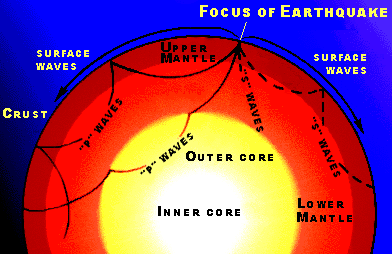 I have always been fascinated by the weather in general, secretly hope to witness a real tornado, and once considered Meteorology as a profession, so crouching under my desk during my first ever earthquake was probably the coolest thing that will happen to me all year. The ground itself was shaking throughout most of the Northeastern United States! Amazing! Much of geology involves slow processes operating over thousands or millions of years, but in an Earthquake, the Earth's crust is disturbed with such force to create pressure waves, like sound waves, that "cause the entire planet to quiver or ring like a bell." How cool is that?!
Such a strong earthquake in this part of the world (the Central Virginia Seismic Zone) is quite rare because the faults are very ancient, having settled down in their old age after spending their wild youth creating the Appalachian Mountains and separating North America from its cross-Atlantic cousins. According to Dr. David Applegate of the USGS (see full transcript here), this is also the reason why these earthquakes are felt so far away from where they occur:
Out in California or in Alaska or where the Earth's plates are grinding against each other, the rock is much more broken up. Here, we have very stable continental crust. It's old crust. It's cold. It transmits the energy very well over long distances.Additionally, the eroding of the Appalachians has built up thick sediments which amplify shaking. Over 100,000 interested people have weighed-in on what they felt during the earthquake to produce the USGS Community Interest Intensity Map showing that light shaking was felt as far North as Canada.

And now we have a hurricane threatening to make landfall in the same area this weekend. It is another rare thing - hurricanes usually hit much farther South.
Every day, all over the world, Nature shows her wrath. For me, violent weather will always be a reminder that Nature is alive. The forces of Nature are going about their business with complete disregard to how humans are spending their time, but we are not separate from Nature, we are Nature, and Nature is Awesome!
Thursday, July 7, 2011
The Inner Reaches of Outer Space
A mythological perspective on why we need the James Webb Space Telescope
On July 6 it was announced that a House Appropriations Subcommittee cut JWST from their proposed budget. JWST is the next Hubble – except it will be bigger and better and more amazing! I won’t go into details about why we need this for science, or for education and public outreach, or for the U.S. position as a world leader in space science and technology, or for supporting innovative STEM research and education that will ensure future economic prosperity and national security for generations to come (!!!) .... because others will do that better. The cosmic variance blog had some very informative posts along with this amazing video:
This video is awesome itself! And it sums up my point: we don’t need Webb because it will cure malaria or do anything else useful; we need it because it is “awesome in the truest sense of the word awesome.” Astronomy is a unique science in its broad ability to be awe-inspiring. The vastness of space puts our daily lives in a different – and sometimes frightening – perspective. Space is the “final frontier,” the last boundary between everything that is familiar and everything else. Space is amazingly empty, but of the 20% of matter that we can actually see, there are a wide variety of stars, planets, galaxies, nebulae, clusters, etc. that are simply beautiful.
The title of this post refers to the last book written by Joseph Campbell: “The Inner Reaches of Outer Space: Metaphor as Myth and as Religion,” of which the first chapter is called “Cosmology and the Mythic Imagination.” (Yea, I study cosmology. Word.) The contemplation of space provided us by the study of astronomy takes us out of ourselves into the great unknown. The feeling of awe is, in my opinion, exactly the feeling that we look for in religion: being a part of something “bigger” than ourselves. But what astronomy does is unite the “us” to be all of Earth and not one society, one religion, or one ethnicity. There’s nothing bigger than THE ENTIRE UNIVERSE! And it turns out we actually are a part of it because it actually exists. Campbell suggests that in Space lives a new mythology, able to invoke a sense of wonder and awe in a way that the old myths, founded in an obsolete 3-layer view of the world, cannot.
So yes, Virginia, we DO need the James Webb Space Telescope. Once Hubble dies for good, it is our best chance of keeping the awesome alive. We need to make a Webb 3D Imax that explores other worlds and their ability to support life, the first stars and first galaxies, the nature of dark matter and dark energy, and the new jewels in the vast emptiness that we have not yet imagined. We need to be reminded of our small and insignificant place in a universe that doesn’t care whether our planet survives. And we need more opportunities to be filled with the awe of being alive.
Subscribe to:
Posts (Atom)